Camas-Washougal logo tag

Camas City Council OKs tax reduction if RFA passes

City will return 71 cents per $1K assessed property value if voters approve regional fire authority in November

By
timestamp icon
category icon Camas, Government, News, Public Safety
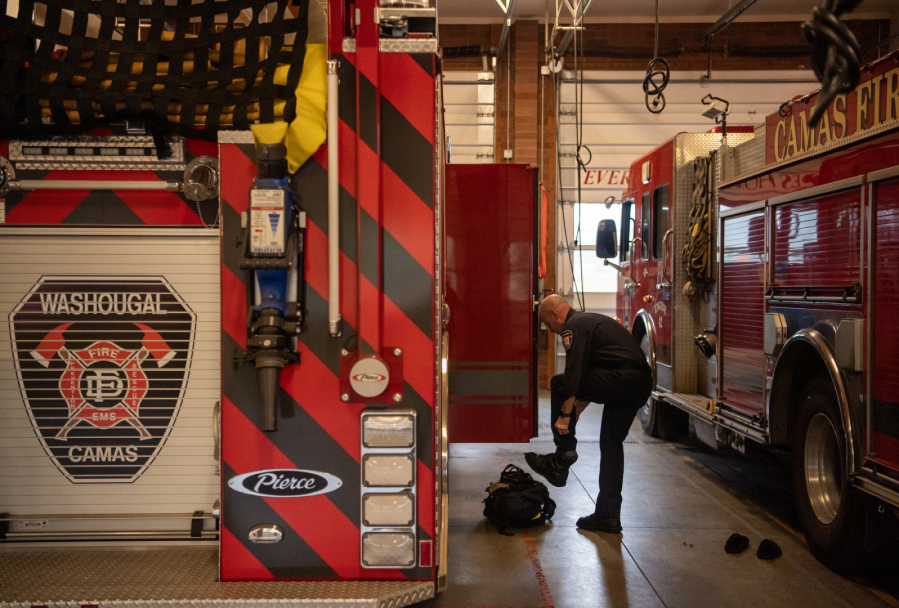
Camas-Washougal Fire Department Capt. James Tierney gears up at Fire Station 42 in Camas. The cities have run a joint fire department for 12 years, but leaders would rather create a regional fire authority. (Taylor Balkom/The Columbian files)

Four months after voters narrowly rejected the formation of a Camas-Washougal regional fire authority, east Clark County officials have decided to sweeten the pot and try again.

If voters approve the fire authority in the Nov. 4 general election, officials in Camas and Washougal will reduce their cities’ property tax levies by the amount currently funding the Camas-Washougal Fire Department.


In July, the Washougal City Council agreed to reduce that city’s property tax bill by 88 cents per $1,000 of assessed property value.

On Monday, the Camas City Council followed suit, voting 5-2 in favor of reducing Camas’ property tax bill by 71 cents per $1,000 of assessed property value if voters OK the fire authority.

Property owners in both cities would see decreased city tax bills beginning in 2027 but would still need to pay $1.05 per $1,000 of assessed property value to fund the regional fire authority.

For the owner of an average Camas home valued at $765,000, the increased regional fire authority costs would be 34 cents per $1,000 of assessed property value. That comes out to about $260 a year, or a little over $21 a month.

‘Struggling with 71 cents’

Camas Councilor Leslie Lewallen, who later joined Councilor Jennifer Senescu in voting against the resolution to lower the city’s property tax bill by 71 cents, said Monday that she was struggling to understand why the finance committee recommended the 71 cents figure after offering to reduce the city’s property tax levy by 60 cents during the lead-up to the April election.

Voters rejected the regional fire authority proposition by a little more than 300 votes in April, with the majority of the “no” votes coming from Camas’ wealthiest neighborhoods.

“I guess I’m just really struggling here. The numbers changed. We put a certain number on the (April) ballot showing we’re being taxed at a certain rate. I’m struggling with 71 cents,” Lewallen said. “I just have a lot of concerns with changing numbers and the changing narrative around this issue.”

In June, Aaron Cliburn, president of the local firefighters’ union, encouraged Camas officials to take another look at how much the city paid for fire services and go back to the voters with updated numbers.

“We have a lack of understanding of what it is the city contributes to the fire department,” Cliburn told The Columbian in June.

He added that the union supports the creation of the regional fire authority.

“We need to be able to govern and support ourselves, so the RFA is the ticket,” Cliburn said in June. “But we can’t support another campaign that doesn’t support 100 percent giveback.”

On Monday, members of the Camas City Council’s finance committee — Councilors John Nohr, Tim Hein and Martin Elzingre — said they’ve been digging through the city’s finances to figure out exactly how much general fund money goes to support the Camas-Washougal Fire Department.

“That’s what the finance committee’s been doing, looking at all the numbers,” Hein said. “That’s how we got to this 71 cents.”

‘Is it worth it?’

Elzingre said Monday that taxpayers will have to decide if the benefits of the fire authority, which include increased firefighter staffing, free ambulance co-pays for all Camas-Washougal residents, long-term stability for the joint fire entity, a greater level of voter control and avoiding the dissolution of the 12-year-old joint fire department, is worth it.

“In order to do what needs to be done, taxes have to go up — by 34 cents per $1,000 with the current RFA,” Elzingre said. “Citizens have to decide: Is it worth it?”

He added that the levy reductions for Camas and Washougal are different due to median home values in both cities and likened comparing the two rates to comparing “apples and radios.”

He added that Washougal’s 88-cent tax reduction amounts to about $3.7 million for the regional fire authority while Camas’ 71-cent giveback would contribute about $5.5 million to the new fire authority.

“Our median property value is much higher, so even with the lower tax rate, we contribute more money,” Elzingre said.

Nohr, who works as the fire chief for Clark-Cowlitz Fire Rescue, proposed bumping the city of Camas’ tax levy reduction from 71 cents to 80 cents to help avoid another Camas voter rebellion in November.

“We’ll pay now or we’ll pay later,” Nohr said. “I think that we need the confidence of voters to feel like they need to do what they need to do.”

‘This RFA will fail’

Following the council’s decision to give back 71 cents per $1,000 of assessed property value, several firefighters and community members lambasted Camas officials for not giving more to ensure passage of the regional fire authority in November.

Former Camas Councilor Deanna Rusch said she’d been watching the council meeting online and rushed down to speak during the public comment period.

“I felt compelled to come down here,” Rusch told the Camas councilors. “Your failure tonight to increase this to a level that will pass is on this body. This is not going to work. This RFA will fail.”

Rusch also encouraged the officials to figure out a way to keep the joint fire department together if the regional fire authority proposal fails a second time.

An interlocal agreement that joined the cities’ fire departments in 2013 states that, if voters reject the fire authority in November, the cities will need to dissolve the Camas-Washougal Fire Department and return to running separate fire agencies.

“The ILA expires, but there are things you can do to stopgap that,” Rusch said. “People in Camas are willing to pay for public safety. It’s time to figure it out.”

Kelly Moyer: 360-735-4674; [email protected]