Camas-Washougal logo tag

Power line worries Columbia River navigators

They fear project could block vessels carrying vital goods

By
timestamp icon
category icon Business, Environment, News
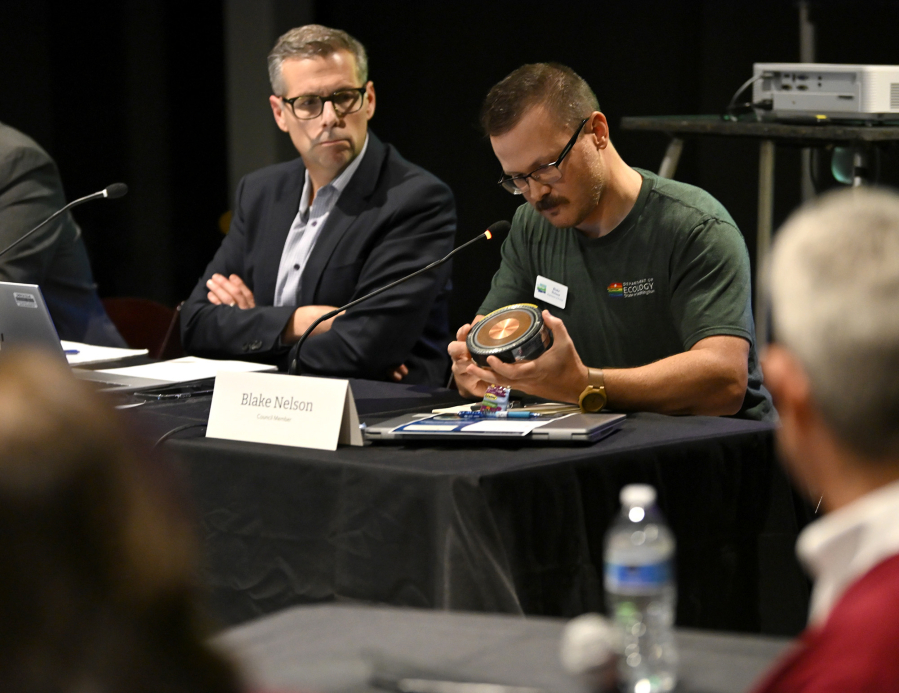
Washington State Energy Facility Site Evaluation Council member Blake Nelson, right, examines a cross section of a transmission cable to be used in the Cascade Renewable Transmission project during a Nov. 17 public meeting at Black Pearl on the Columbia in Washougal. (Taylor Balkom/The Columbian files)

Columbia River navigators are growing worried as a project to put a 100-mile power transmission line under the river charges ahead without offering ways to mitigate its impacts on the industry.

The Cascade Renewable Transmission project’s 1-foot-thick line would run from The Dalles, Ore., to the Vancouver-Portland area, with most of it being buried under the river.

But shippers worry that the project’s construction may block vessels carrying grain, trash, riverboat passengers and the fuel that keeps Eastern Washington running.

Energy security worries

“There have been times before where folks have been within days or less of running out of fuel,” said Neil Maunu, who runs the Pacific Northwest Waterways Association. “And that’s everything from heating your home with heating oil because you live in Eastern Washington, or diesel fuel to run your trucks.”

While Eastern Washington also gets fuel from pipelines, freight trains and trucks, Maunu said a significant percentage of the region’s fuel comes from hundreds of barges each year that move the commodities from Portland to the Tri-Cities.

That has included jet fuel shipments for Fairchild Air Force Base and wildland firefighting planes, he added.

Vancouver-based Tidewater Barge Lines is the main company that barges fuel, as well as other key commodities, between the Vancouver area and ports east of the Cascades.

A spokesperson for the company didn’t answer how much fuel its barges move each year. But Tidewater CEO Johan Sperling said it’s crucial for all river users to communicate early and coordinate operations closely to keep the shipping system predictable.

“However, if in-water work is not well coordinated,” he added in a statement, “it could create avoidable challenges for vessels and operators on the system, including Tidewater and our customers.”

Maunu said balancing everything to keep cargo moving on the river is tremendously difficult and pointed to routine lock maintenance at the dams as one example of that.

“We — the stakeholders and folks like Tidewater and all their terminals — have to plan months and months ahead of time so they know how they’re going to get that fuel and where they’re going to get that fuel from during that outage,” he said.

Riverboat cruise line operators, grain exporters and trash barging operations could also be impacted.

Navigators move tens of billions of dollars of goods on the river each year, though most of that is from Vancouver-Portland out to the Pacific.

Coordination

Maunu said his team had met with the Cascade Renewable Transmission project’s staff about a year ago to share concerns but hasn’t heard anything since.

“And maybe there’s a plan, but we’re not aware of any coordination that’s occurred yet,” he said. “It’s something, from our standpoint, that we feel we should be raising to have the conversation now, before decisions are made that are going to impact us.”

Chris Hocker is the transmission line’s project lead for Connecticut-based PowerBridge. He said regional shippers’ interest in the project was “totally understandable,” but he felt the conversation would make more sense closer to when the cable is laid.

“I don’t believe there’s been a breakdown in communication,” Hocker added. “We have continued to refine the planning and the route and the preparation of the permits. And if you’re telling me they feel that they should hear from us again soon, I have no problem with that.”

At a permitting hearing in Washougal last month, Hocker explained that the cable would be laid from a barge moving 1 mile to 1½ miles a day, and would crisscross the shipping channel.

Hocker said that work would be done in the winter to avoid some salmon runs.

Capt. Jeremy Nielsen is president of the Columbia River Pilots, an organization that pilots ships on the Willamette and Lower Columbia rivers, as well as up the Columbia to the Tri-Cities area on occasion.

“I commend them for thinking outside the box,” he said, acknowledging the region’s power transmission infrastructure shortage. “But the navigation channel is for navigation. It’s not a right of way for anything else.”

Nielsen said that while it’s easy to coordinate with dredge barges operating in that stretch of river — the pilot lets them know they need to pass, and the vessel moves — he isn’t sure a barge that’s actively laying a cable could get out of the way like others do.

“When environmental conditions get nautical — higher wind or higher current — you have to use up your real estate really quick,” the longtime captain said. “The channel that we go on is relatively narrow. There’s not a lot of space, so a barge doing underwater work like that at that pace could impact navigation.”

Hocker said those concerns are speculative and the right time to address them alongside other potential navigation issues will be in a group planning meeting sometime in the future.

Channel depth worries

Maunu said another huge worry among navigators is if the transmission cable project will end the region’s long-term dream for a 27-foot shipping channel from The Dalles to Portland.

While the channel between Portland and The Dalles is only dredged to 14 feet now, Congress has approved it to 27. By comparison, the channel downriver from Portland to the Pacific is maintained at 43 feet.

Maunu said he worries the goal of deepening the channel east of Portland would be permanently ended if the cable is put 10 feet to 15 feet under the riverbed, as the project has said it would.

“Maybe they’ve mitigated that, or maybe they have an explanation for how they’re going to work around it,” Maunu considered. “But that’s one challenge.”

“That one I can answer,” said Hocker when asked about the line’s depth. “Anything within the channel is determined in terms of authorized depth, so if there’s 13 feet of sediment above authorized depth, we have to go deeper than the authorized depth.”

That means the cable would be between 23 and 28 feet under the riverbed, he said.

But Hocker also said conditions in the riverbed may not allow for that depth in some small areas, both inside and outside of the shipping channel. In those circumstances, he said the cable would be covered with large concrete sheets known as “mattresses.”

That would also protect against anchor strikes and damage from the legs of some barges.

Maunu and other regional shipping industry players, however, had not heard any of that.

“PNWA and our stakeholders certainly don’t know enough to endorse or oppose this project at this time,” he said. “We’re in the information-gathering phase.”

But Maunu, Sperling and others emphasized they felt the project could coexist with shipping — if there’s communication.

“From Tidewater’s perspective, the key factor is coordination,” Sperling wrote. “With proper planning, transparent communication, and clear scheduling, the Cascade Renewable Transmission Line Project does not have to create significant disruptions for commercial navigation.”

Henry Brannan: 360-735-4530; [email protected]; @henry_brannan

About the project: The Murrow News Fellowship is a state-funded journalism project managed by Washington State University. Local partners are The Columbian and The Daily News. For more information, visit news-fellowship.murrow.wsu.edu