Camas-Washougal logo tag

Washington officials assess as fire season closes

By
timestamp icon
category icon Environment, News
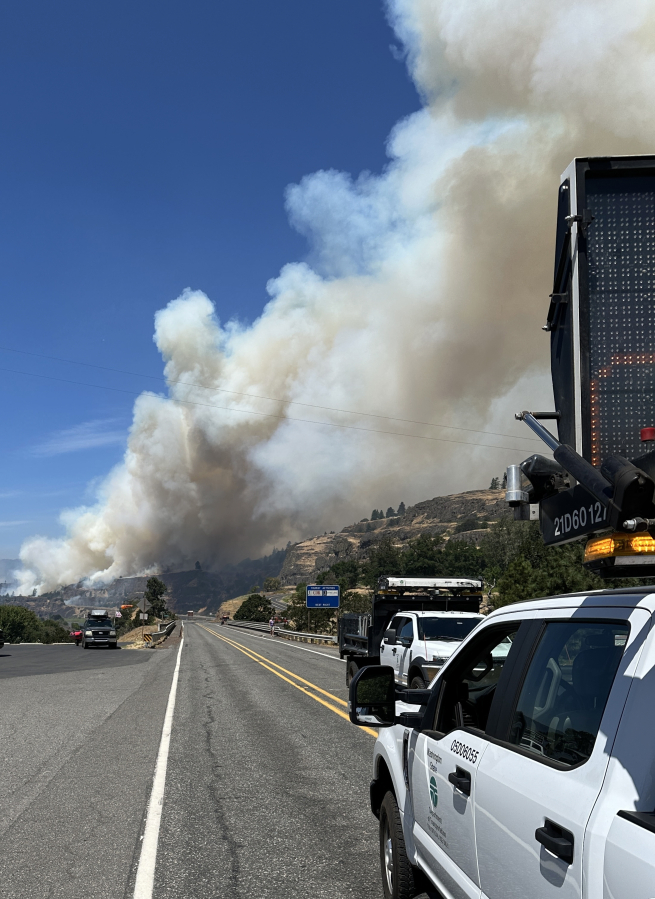
Smoke from the Burdoin Fire towers over the closed state Highway 14 in the Columbia River Gorge. The blaze burned nearly 11,000 acres. (Washington State Department of Transportation)

With fall weather dampening wildland fire conditions in Washington, officials are beginning to reflect on the fire season.

Washington saw more individual fires than last season, but fewer acres burned, preliminary data shows. Several sizable fires are still burning.

As of Friday, there were 251,840 acres burned in Washington and 1,851 documented ignitions, according to Northwest Interagency Coordination Center data released by the state Department of Natural Resources.

The data is not specific to Department of Natural Resources-managed lands, and encompasses wildland fire activity across all of Washington.

The numbers include the current acreage for the two fires still burning in Central Washington, as well as several other active fires across the state.

The Labor Mountain Fire and the Lower Sugarloaf Fire in Central Washington were both partially contained as of Monday afternoon.

The Bear Gulch Fire in the Olympic National Forest is also still burning, but fire management personnel determined last week that the threat of further damage from the fire is minimal. The Tunnel Creek Fire, similarly, has mostly stopped growing due to the shift in weather.

The total acreage burned so far this year is below last year’s total of 274,593 acres and the five-year average of 423,436 acres.

“Unless something unexpected happens, Washington will likely experience slightly fewer or a similar number of total acres burned statewide as last year,” Department of Natural Resources spokesperson Thomas Kyle-Milward said.

Fire ignitions, however, are higher than last year’s total of 1,806 and the five-year average of 1,629.

Ignitions include anything that starts a fire, such as weather, human activity and undetermined causes. False alarm reports are not included in the data.

Kyle-Milward described this year’s wildland fire season as “average to above-average,” noting that fire activity was consistent with projections for the season.

Finalized data for 2025 will be released in January.

With temperatures mellowing and rain beginning to fall, the Department of Natural Resources does not expect any further fire activity in Central and Eastern Washington this season.

“Fall weather is mitigating conditions,” Kyle-Milward said.

Because conditions have become favorable, the Washington Department of Fish and Wildlife announced last week that it plans to start conducting prescribed burns on the lands it manages in Eastern Washington.

The agency conducts prescribed fires during conditions that favor low-intensity burning, such as in the spring and fall, to improve ecosystem health and reduce the risk of wildfires.

“Fire rejuvenates important native grass and brush favored by deer and elk, as well as small mammals and bird species, while providing improved ecosystem health and resiliency, reduced wildfire intensity, and improved access for recreational users,” said Matt Eberlein, prescribed fire program manager with the Department of Fish and Wildlife.

The agency plans to treat 300 acres on the L.T. Murray Unit of the L.T. Murray Wildlife Area about 15 miles west of Ellensburg. It will also partner with Chelan County, the United States Forest Service, and the Washington Department of Natural Resources to treat 36 acres in the Stemilt Basin in the Colockum Wildlife Area.

Additional burns on Department of Fish and Wildlife-managed Eastern Washington lands may be announced later this fall.

All burns are weather-dependent and will not occur if conditions are not optimal for safe and effective prescribed fires, Fish and Wildlife stated.

The Department of Natural Resources launched its own prescribed fire program in 2021, when state lawmakers approved a bill committing $500 million over eight years for wildfire preparedness and response.

The Washington State Standard is part of States Newsroom, the nation’s largest state-focused nonprofit news organization, and is a nonprofit, nonpartisan news outlet that provides original reporting, analysis and commentary on Washington state government and politics.