Camas-Washougal logo tag

Washougal library fundraiser speaker Roni Sasaki has an ‘Olympic mindset’

Ski racer born with one leg, has proved doubters wrong

By
timestamp icon
category icon Arts & Entertainment, Life, Washougal
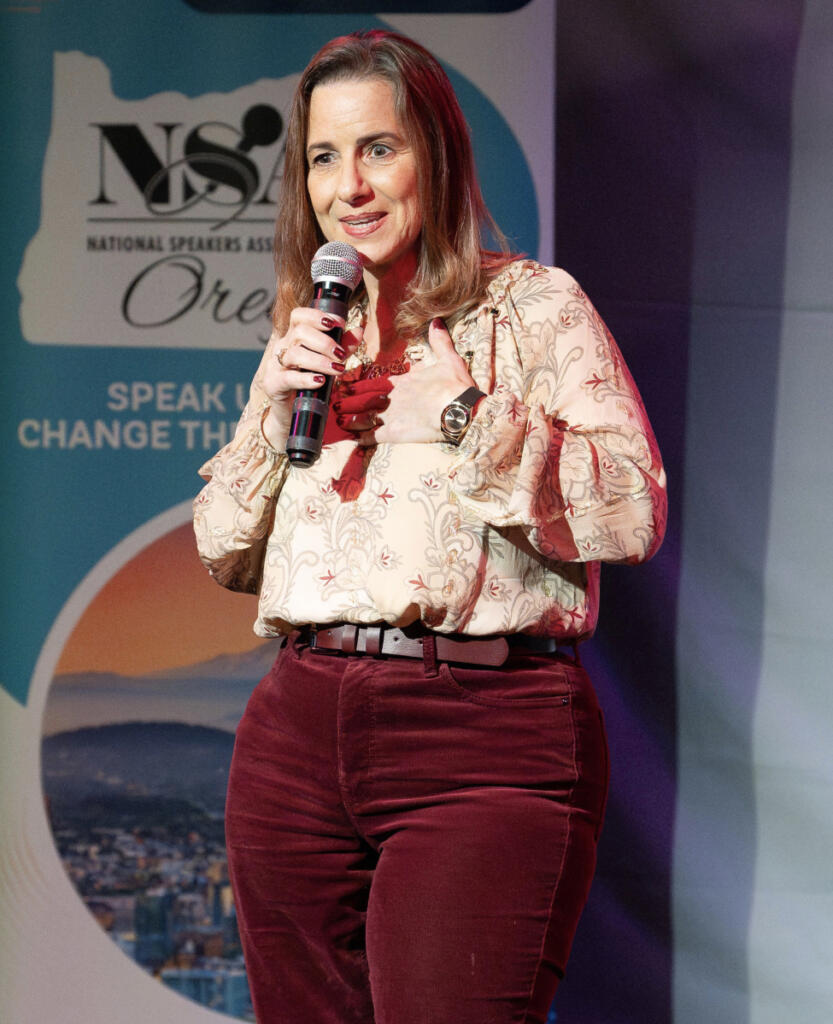
Roni Sasaki has been proving people wrong from the very beginning. A doctor declared that Sasaki, who was born with only one leg, would probably never walk. She learned to walk on an artificial leg just before her second birthday.

But walking was never one of her major problems. Her greatest struggle as a youngster was learning to love and accept herself for being “different.”

“When I was a kid growing up, it bothered me because I wanted just desperately to fit in, like all kids do,” she said.

Sasaki went on to become a gold medal-winning skier, a successful business owner and a renowned public speaker, partially due to her refusal to accept her disability as a weakness. Instead, she turned it into a strength.

“It gave me some kind of a weird determination to prove myself more than anything,” she said. “Because I had one leg, I desperately wanted to show everybody that I was normal and that I could do everything that they could do, even though I did it maybe a little differently. That has kind of permeated every aspect of my life. I’m very driven and have a desire to do well in everything that I try to do.”

If you go

What: Stories, Songs & Community: An Evening to Remember fundraising event for Washougal Community Library

When: 6 to 8:30 p.m. April 30

Where: Washougal High School Auditorium, 1201 39th St., Washougal

Admission: $18

Information: washougallibraryfriends.org

Sasaki is scheduled to speak during the Friends of the Washougal Community Library’s Stories, Songs & Community: An Evening to Remember fundraising event Thursday at Washougal High School.

“She talks about how having one leg growing up created a lot of opportunities that she wouldn’t have been able to have,” said Cindy O’Mealy, the president of the Friends of the Washougal Community Library group. “Her perseverance, her belief that she can do it and her attitude about life really stuck with me when I heard her story. She has touched many people through the years.”

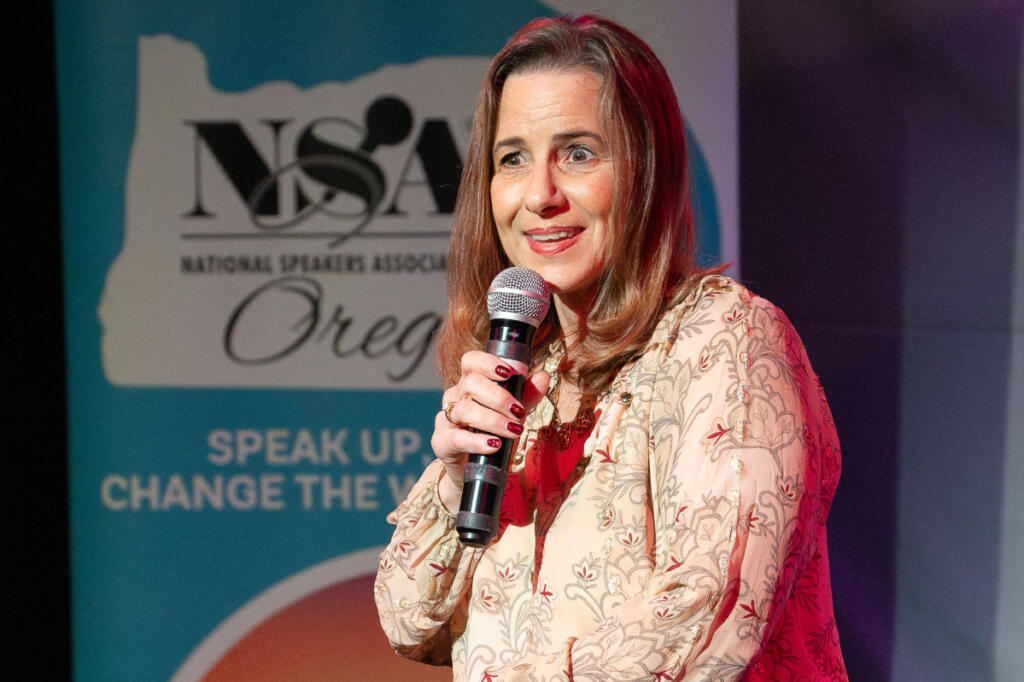
Sasaki won the National Speakers Association Oregon Chapter’s Last Story Standing competition March 4 at the Chapel Theatre in Milwaukie, Ore., to qualify for a regional competition, conducted by video submissions. The National Speakers Association will choose three regional winners to compete at the NSA Influence 2026 national convention in Austin, Texas, from July 25 to 27.

“I love speaking,” she said. “It’s a passion. It’s funny. I get nervous before I speak, but when I get up there and start talking, all of a sudden, I feel like I am at home with the audience.”

Sasaki started speaking publicly when she was 16 after a counselor at a Christian camp she was attending asked if she would share her story. She continued speaking as an adult, using the funds raised from speaking engagements for her ski racing career and other activities. She decided to turn it into an official “side gig” in 2018.

“When she speaks,” said her husband, Derek Sasaki, “she speaks with passion, intelligence and power. I never see her get stage fright.”

Roni Sasaki believes that every person is uniquely designed with uncommon characteristics for greatness. She encourages people to embrace what they perceive as imperfections and to not let the “fear of falling” hold them back.

“I hope that they believe in themselves a little bit more (after hearing me speak),” she said. “Maybe they have wanted to give up and my story gives them a little bit of a boost to keep trying, keep going, pick themselves back up.”

Roni Sasaki’s skiing career was driven by that same fierce determination to belong and defy expectations.

“When I was young, I wanted to be an athlete because all the popular kids were good athletes,” she said. “I was a terrible athlete, but I learned to ski because I had seen one-legged skiers on TV thought, ‘If there’s one-legged skiers on TV, maybe that’s something I could be good at.’”

Sasaki and her parents began cold-calling people looking for somebody to teach her how to ski. Eventually, her name landed in the hands of a ski instructor who worked for Shared Outdoor Adventure Recreation, an adaptive recreation program in Portland.

One day, the instructor called Sasaki and asked the high school senior, “Do you want to learn how to ski?” Sasaki enthusiastically accepted the offer and, after working with the instructor for two years, entered her first competitive race.

“I just fell in love with ski racing,” said Sasaki, who attended Portland State University. “I decided that when I graduated from college, I was going to pursue ski racing full time.”

She moved to Winter Park, Colo., to train with a disabled racing program, aspiring to join the then-United States Disabled Ski Team and eventually the U.S. Paralympic squad.

“Because I had never really been super athletic as a kid, everything about skiing was exciting,” she said. “Every day was like a dream come true, essentially. It sounds kind of corny, but when you think something is impossible and is never going to happen, and then it begins to happen and take shape, it’s even more exciting, even more so for a person who has to really scrap their way through it and figure out a way when all odds seem to be stacked against them … to make it happen.”

Get the latest headlines in your email every week!

This field is for validation purposes and should be left unchanged.

Sasaki’s hard work was rewarded when she was named to the U.S. team ahead of the 1992 Winter Paralympic Games, held in Albertville, France. She competed in four events and won medals in three of them: gold in the Women’s Super-G LW2 event and bronze in the Women’s Downhill LW2 and Women’s Slalom LW2 events.

Her medal haul showed how a voracious work ethic can overcome relative weaknesses in other areas, Derek Sasaki said.

“She worked her butt off to get the gold medal,” he said. “When Roni chooses to go for the gold, she goes for it. She has the Olympic mindset — the mind of a champion. If she chooses to do something, she’s going to do it. If there’s a problem, she’ll try to figure out a way to get a solution.”

Roni Sasaki carried that mindset into the next chapter of her life as a businesswoman. In 1995, guided by her parents, the owners of a concrete business, she founded EnviroMet, a Vancouver-based industrial supply company that still operates today.

“Having integrity in everything I do, the way I treat my employees, the way I treat my suppliers, the customers, is absolutely imperative,” she said. “I want to be able to sleep well at night, and sometimes I have to make decisions that were not in my favor because it was the right thing to do.”

In business and beyond, Sasaki refuses to be defined by her disability. She views herself as “a normal person like everybody else,” though she concedes that not everyone has to start their day by putting on a prosthetic leg like she does. She has long since cast aside her childhood need for acceptance and embraced her distinctiveness, which, in her mind, is the reason for her success.

“She’s accepted it,” Derek Sasaki said. “She feels very blessed that she’s made that way. She’s never let her disability slow her down. Her belief in God and how she was wonderfully designed has driven her to be the best Roni she can be.”