Camas-Washougal logo tag

Northwest Power and Conservation Council says needs can be met

Renewable resources, natural gas generation, conservation cited

By
timestamp icon
category icon Clark County, Environment, Government, News
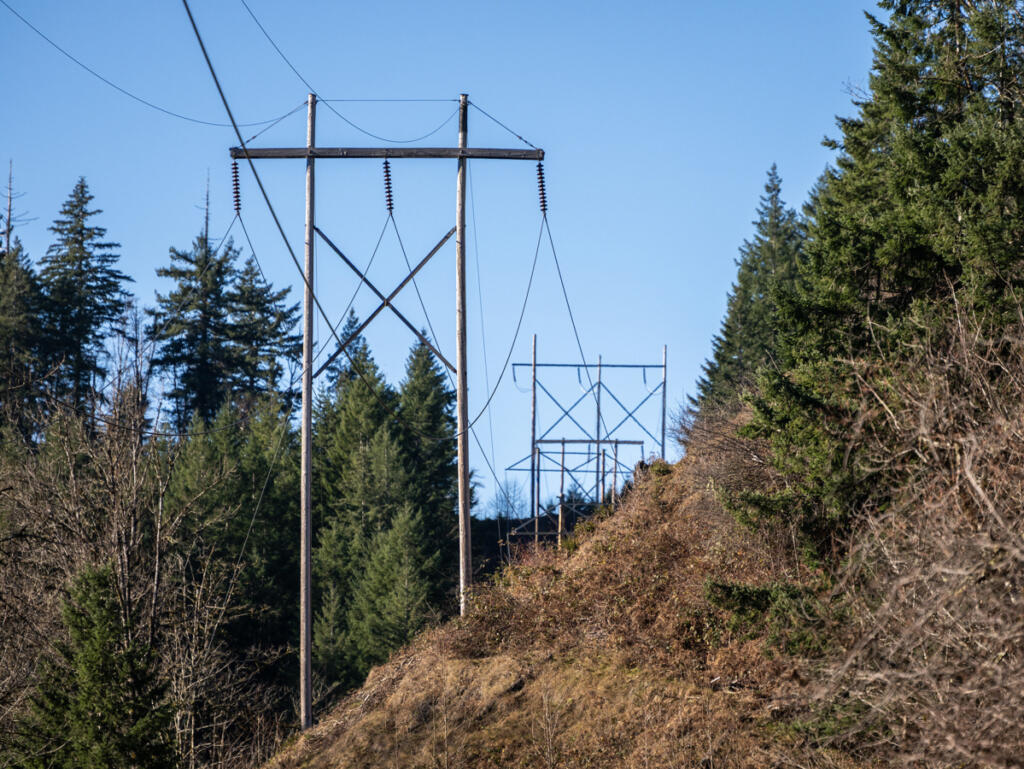
Transmission poles support wires Jan. 16 near Swift Dam in Cougar. A draft plan released by the Northwest Power and Conservation Council addresses the region’s power needs in the coming years. (Taylor Balkom/The Columbian files)

Data centers, growing tech demands, continuing electrification of cars and homes, and extreme weather events could push the region’s power needs into uncharted territory.

New recommendations, however, suggest additional renewable resources, storage, natural gas generation and conservation should cover the growing demand for power in the region.


On Thursday, the Northwest Power and Conservation Council released a draft of what it calls its Ninth Power Plan. The document digs into how much power the council estimates the region will need in the years ahead, incorporating both supply and demand considerations. The public has 65 days to comment on the plan, including at virtual and in-person public hearings throughout Washington, Oregon, Idaho and Montana.

Jennifer Light, director of power planning at the council, said a balance of wind and solar, storage for solar and additional natural gas generation will be key.

“That together is what’s really helping to make up the rest of the portfolio and ensuring adequacy,” Light said.

The council recommends the region conserve 1,060 average megawatts each year, 860 of those specifically for the Bonneville Power Administration, its customers, and investor-owned utilities in Washington and Oregon.

The recommendations also state that the region should use 220 megawatts of voltage regulation, a method used to lower voltage on distribution lines for a time; as well as 590 megawatts of demand response, a tool allowing customers to lower their electricity use when local or regional demand is high.

The council estimates the region also will need to add 5,200 megawatts of storage, primarily located near renewable resources, as well as 9,000 megawatts of renewable generation.

The entire region currently is capable of generating roughly 70,000 megawatts of energy, according to Northwest Power and Conservation Council data. About 15,000 of those megawatts are represented by gas and coal. Renewables and storage, meanwhile, represent about 17,000 megawatts.

New natural gas generation isn’t exactly banned in the Northwest, but it’s severely limited in Washington and would need to be offset through the state’s carbon market.

Get the latest headlines in your email every week!

This field is for validation purposes and should be left unchanged.

Clark Public Utilities expects to power down its River Road Generating System by 2045 to meet state regulations.

The council recommends, however, the region add 2,100 megawatts of natural gas, primarily in Idaho and Montana but some in Washington.

“They’re primarily used for what I would frame as seasonal reserves, really hedging against low hydro conditions,” Light said. “Otherwise, they’re not generating.”

Light said Washington is expected to build enough renewable resources to meet its load by 2045, when its electricity supply is supposed to be carbon free.

“Any gas that’s still generating there is really just getting exported and delivered to other loads,” Light said.

The council released its 20-year load forecast last year, projecting the region’s energy needs could grow up to 3 percent in the decades ahead.

Demand hasn’t grown so quickly in the Northwest since the 1960s.

The council aims to adopt the plan by the end of this year or early next year.