Camas-Washougal logo tag

Clark County Council considers changes to rules, procedures

Among questions at hand: When can a member be removed from a board or commission?

By
timestamp icon
category icon Clark County, Government,
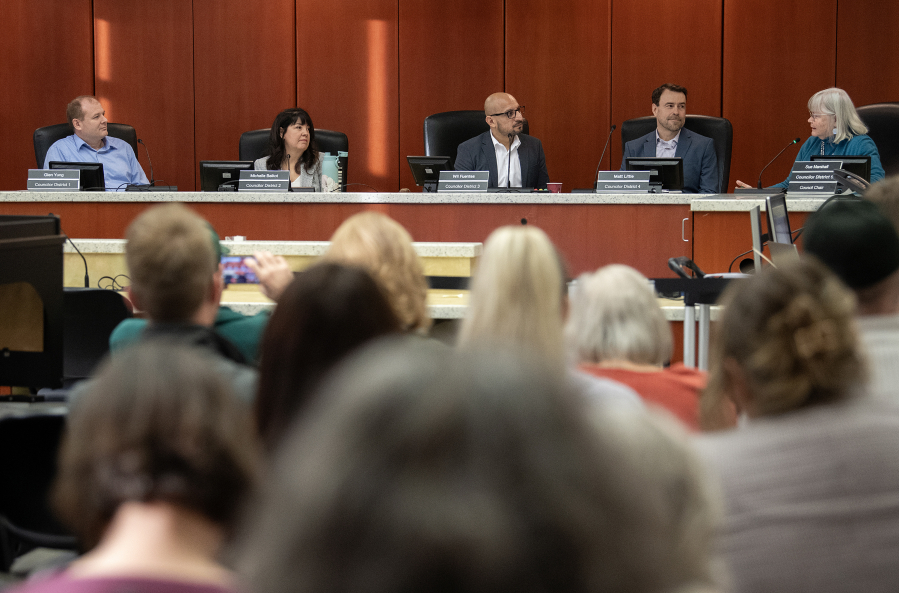
Clark County Council members Glen Yung, from left, Michelle Belkot, Wil Fuentes, Matt Little and Sue Marshall discuss agenda items at the council’s first meeting of 2025. (Amanda Cowan/The Columbian files)

When, and under what circumstances, can the Clark County Council remove council members from a board or commission?

The council on Jan. 28 debated that question as it considered possible changes to its rules and procedures.


The revised rules and procedures would include two new items related to removing councilors.

The first states that the council may remove its members from boards and commissions with a simple majority vote.

The second new entry states the council may, by a simple majority vote, direct an individual councilor appointed to a board or commission on how to vote on specific policy items.

The new language would apply to councilor appointments only on outside boards and commissions, not county committees like the parks advisory board, planning commission and so forth.

“Obviously, this is all stemming from you all removing me from C-Tran. Let’s be real here,” Councilor Michelle Belkot said during the meeting.

Belkot said she didn’t think the language proposed was legal nor aligned with the county charter.

County Manager Kathleen Otto said the charter does not address the removal of councilors but said the new procedure language is consistent with what the charter says about how councilors are appointed.

On March 12, the council voted 4-1 to remove Belkot from the C-Tran board after she broke ranks the day before at a C-Tran board meeting when she objected to local taxpayer funding for light rail on the planned Interstate 5 Bridge replacement. Chair Sue Marshall, who also serves on the C-Tran board, said the council spent a lot of time deliberating on the vote ahead of the C-Tran meeting, ultimately voting 4-1 in support of the funding, with Belkot the lone dissenting vote. Marshall said Belkot’s vote should have represented the will of the council, not her personal opinions.

However, Belkot disagreed and said she was not obligated to vote in line with the rest of the council. Belkot filed suit against the county in federal court shortly after being removed. The case is scheduled to be heard in July.

“What would be the point of any of you being elected if we’re all supposed to take lockstep votes? That has never been the county council,” Belkot said.

Marshall said there are rare instances when the council has to take a position on an issue as a whole, which is done through deliberations and a majority vote. She said there would be no point to all of that effort if individual councilors weren’t going to uphold those votes.

Belkot also said she wanted to include language that a councilor would be removed from their seat if convicted of a crime.

Other changes to the rules of procedure include moving the pledge of allegiance to the start of Tuesday meetings, ahead of the invocation and any special recognitions. Currently, the pledge is said after both. Open public comment also would be moved to earlier in the Tuesday meetings.

Marshall also said further clarification was needed for other aspects, such as when the council can reconsider a matter on which it has already voted. Last year, the council reconsidered its votes on an agricultural land study, Belkot’s removal from the C-Tran board and the FBI’s contract to use the Camp Bonneville shooting range — decisions that Marshall warned could undermine residents’ trust to stand behind council decisions.

A revised draft will come back before the council for approval within the next two to three weeks. Once the council approves the revised rules, a public hearing will be held to allow people to comment on the proposed changes.