Camas-Washougal logo tag

Report: Cost of housing driving homelessness

Domestic violence another top reason for housing instability

By
timestamp icon
category icon Clark County, News
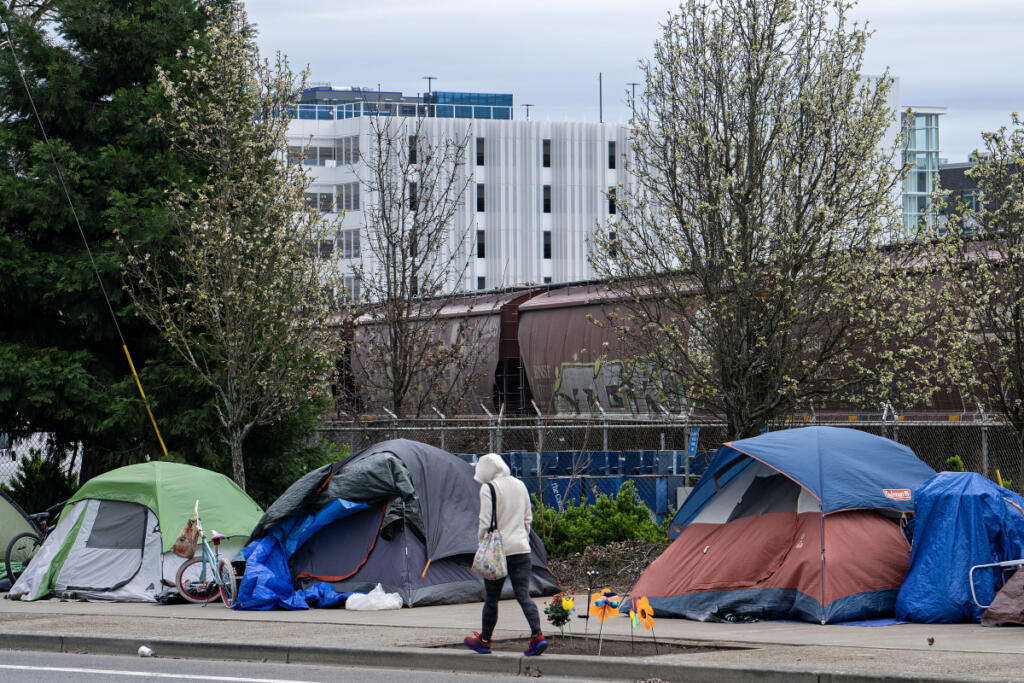
A train passes by a homeless encampment in downtown Vancouver in March. The number of people who accessed the Clark County’s homeless system decreased slightly from 2024 to 2025, yet housing leaders say it remains a critical issue. (Amanda Cowan/The Columbian)

About 4,500 people became homeless in Clark County in 2025, according to a report released by Council for the Homeless on July 9.

That’s 55 percent of the 8,201 people who accessed some sort of homeless assistance in Clark County over the past year. The report collected data from 47 agencies.

Although 2025’s total is about 8 percent lower than the 8,894 tallied in 2024, housing leaders emphasized that homelessness persists.

“Our community is working hard and we are seeing signs of progress. But the reality is that too many of our neighbors are still one financial setback or one rent increase away from losing their housing,” Council for the Homeless CEO Sesany Fennie-Jones said in a news release.

Here’s how the numbers break down:

  • 2,334 children — 803 of them under age 5 — experienced homelessness in 2025, compared with 2,583 in 2024;
  • 1,211 adults 55 and older were homeless, compared with 1,219 in 2024;
  • 3,450 people who entered the homeless system last year were Black, Indigenous or other people of color, compared with 3,868 in 2024.

People of color accounted for 42 percent of those experiencing homelessness, even though they comprise about 25 percent of Clark County’s overall population, according to the report.

“We’re seeing the numbers of families that are experiencing housing instability and homelessness increasing at a rapid rate. Those families are mostly BIPOC. Why is that? We need to be asking ourselves really hard questions about what is happening throughout our community,” Fennie-Jones told The Columbian.

The report shows that the primary driver of homelessness continues to be the rising cost of housing, specifically for households earning 50 percent of the area’s median income (about $43,450 for an individual).

“We know that the minimum salary does not cover a person that is even living in a one-bedroom apartment, so if you add a child or two children to that makes things even more difficult,” Fennie-Jones said.

While an individual without children needs to earn about $26 an hour to cover basic necessities such as food, rent and healthcare, a single parent raising two children needs to earn about $60 an hour, or $125,836 a year, according to Massachusetts Institute of Technology’s Living Wage Calculator.

Domestic violence was the second most common reason people fell into housing instability, according to the report. Other reasons included eviction, household crisis and substance use.

Contrary to the widely held belief that homeless people move here from out of state, most are from Clark County. According to the report, 5,337 or 81 percent had Clark County addresses before they became homeless.

‘A way out of this’

The report found Clark County’s homeless system helped more people find stable housing in 2025, although the demand continued to overwhelm services.

The phone rang more than 50,000 times at the Council for the Homeless’ Housing Hotline last year. Each call represented a resident searching for either a place to live or a resource to prevent them from losing their housing. Yet that’s a 20,000-call drop from 2024.

Ninety-two percent of those entering permanent supportive housing in 2025 remained there or found another stable place to live. Meanwhile, of those in supportive housing overall, 20 percent returned to homelessness.

“We need to focus on creative solutions to homelessness throughout their community, and I don’t think we’ve gotten there yet. I think there’s a lot of talk about different ways to create housing, and we’re still in a very much a talking stage, and trying to figure things out,” Fennie-Jones said.

The report showed that the homeless response system had less capacity in 2025. Although thousands of households were assessed for help, the loss of funding provided during the COVID-19 pandemic has meant fewer families could be placed in housing programs. That decline reversed the 25 percent growth in program placement that the system saw from 2023 to 2024.

Rent assistance resources also became increasingly limited, according to the report. The percentage of family households stabilized through rent assistance decreased by 5 percent.

“We need flexible dollars. That’s going to allow us to create the programs and services that are going to maintain housing and get people housed. Because if that’s not the case, we’re going to continue to see this cycle of homelessness and instability that happens for people and for families,” Fennie-Jones said. “But there is a way out of this.”