Camas-Washougal logo tag

Buoy 10 salmon fishing season looks good

Popular fishery opens on Aug. 1

By
timestamp icon
category icon News, Outdoors, Sports

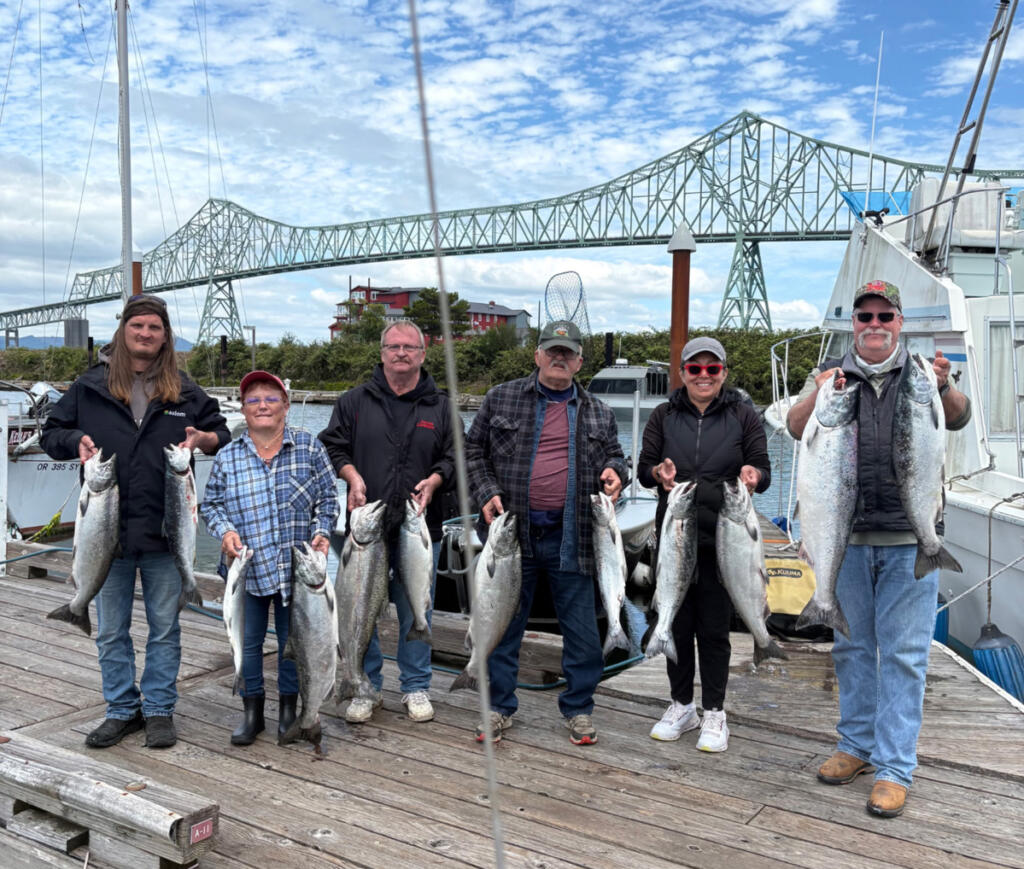
The Buoy 10 fishery, the largest salmon fishery in the lower 48 states, will kick off on Aug. 1 at the mouth of the Columbia River.

Catches have been good in the ocean off the mouth of the Columbia, especially for coho salmon. This could indicate another fine season in the popular fishery.


The season schedule is very similar to last years, with the fishery allowing for hatchery coho and any chinook to be kept from Aug. 1-9, with a two fish daily limit, only one of which can be a chinook.

From Aug. 10-24, the retention of hatchery chinook and hatchery coho will be allowed. The daily adult bag limit is two salmon, but only one may be a chinook. All wild chinook must be released.

From Aug. 25 to Sept. 2, the retention of any chinook and hatchery coho will be allowed. The daily adult bag limit is two salmon, but only one may be a chinook.

During these fisheries, all wild coho must be released. The hatchery salmon can be identified by a clipped adipose fin.

The in-river reaches are also basically the same as in 2025, with the Buoy 10 fishery described as from the Buoy 10 at the mouth of the river, to Tongue Point. Each separate reach has different openings and closures.

Check the full Columbia River in-season regulations online at https://www.dfw.state.or.us/fish/oscrp/crm/index.asp

This year’s adult fall chinook forecast is for 636,500 fish, which is lower than the 2025 actual return of 685,512 adult fish. The Columbia River coho forecast is for a return of 358,700 adults, and is also lower than last year’s return of 471,411 fish.

Columbia River fishing guide Jack Glass of Team Hookup Guide Service out of Portland has been fishing Buoy 10 for decades, and he is looking forward to it again.

With the similar forecast, and the reports he has heard, Glass is expecting a repeat of the fine fishing they experienced last year.

Glass was towing his boat to Astoria, Ore., this past Monday, while the other half of Team Hookup, his son Brandon, has been fishing the ocean off the Columbia for a few days. He has been limiting the boat every day.

There were plenty of chinook in the mix, too.

“My reports from Brandon are that he is catching a lot of kings in the ocean,” said Glass, “and there are a lot of tules this year.”

That can be a good thing. Tule chinook, an early returning fall chinook, are one of the main constraints on the Buoy 10 fishery.

Glass said he will start by fishing the ocean, but he will fish the river on the first day of the fishery, Aug. 1.

“All the biters mostly get caught the first day,” he said. “The second and third day, there’s not much for biters, so I will fish out in the ocean.”

His plan is to come back inside on Aug. 10, which he said is when the fish really start to enter the Columbia in good numbers.

“On the 10th, the run really starts coming into the river, so I will stay in the river after that.”

The fishing techniques used in this fishery have evolved over the last 10 to 15 years.

Gone are the triangle flashers, and most of the use of real bait.

Most anglers are now trolling with the 360 flashers, and the usual offering at the business end is now the plug-cut lures such as the Brad’s Super Bait and Yakima Bait’s Cut-Plug.

These are plastic lures that can be loaded with an attractant, such as tuna, and they spin when trolled.

Get the latest headlines in your email every week!

This field is for validation purposes and should be left unchanged.

Glass said these new techniques have revolutionized salmon fishing. The new baits reduce the money spent on fresh bait — and they work. The fish bite them.

The 360 flashers, which pulse when trolled, are incredibly affective, too.

But Glass said there is a caveat.

“In my opinion, the new baits and 360 flashers are a good thing and a bad thing,” he said. “It’s really changed the fishery. Now everybody can catch fish.

“Remember when 10 percent of the fishermen caught 90 percent of the fish? It’s not like that now.”

Glass also reported that it has made the fishing so much easier there are more guides jumping into the business.

Another downside is that quotas can be caught much more quickly. That is where the select fishery helps, when you can only keep hatchery chinook.

That slows the retention of chinook, which better allows the fishery to stay open for the entire season. In years past, fast catches sometimes caused the fishery to be closed down early.

Glass reports that understanding the tides are a big part of this fishery.

“When there are big swings on tides then I fish down by Buoy 10 and the lower river, because the fish are pushing in,” he said. “On hold-over tides, (smaller tides), we fish above the (Astoria-Megler) bridge. They slow down and don’t move through as fast, so we catch them above the bridge.”

Glass did point out that the impacts on the wild fish can shut the fishery down, and the wild tule chinook are the largest constraint. If too many are caught it could close the fishery.

Tules are a poor-quality salmon once they move upstream, but are still of good quality at Buoy 10.

However, even though they are a good table fish, and they can at times be kept, they should be released. If too many are kept, it could impact the fishery.

It takes some experience to tell a tule from an upriver bright chinook. The brights are a later spawning chinook, and they stay fresh longer. They are shaped more like a torpedo, and their adipose fin is much smaller than a tule’s.

This video posted by the Addicted Fishing Group displays the difference: https://www.instagram.com/reel/DNa5EPUxfl3/?hl=en

“The whole Columbia River is always managed on impacts on wild fish,” Glass said. “People need to be aware that keeping those wild tules has an impact on our resource.”

This fishery can see many hundreds of boats operating in the river and the ocean on a single day. Safe boating practices are an absolute must.

There have been some serious accidents in recent years, so pay close attention to what is going on around you. It is a good idea for the uninitiated to hire a guide before trying these waters yourself.

In addition to the crowding, the tides often create dangerous currents. This is not place for novices.

Anglers are also reminded that the different reaches all have different rules and open days. Always check the regulations before fishing.