Camas-Washougal logo tag

Clark County Council concerned about health, safety permit fees

Councilors worry increases would hurt businesses

By
timestamp icon
category icon Clark County, Government, Health, News
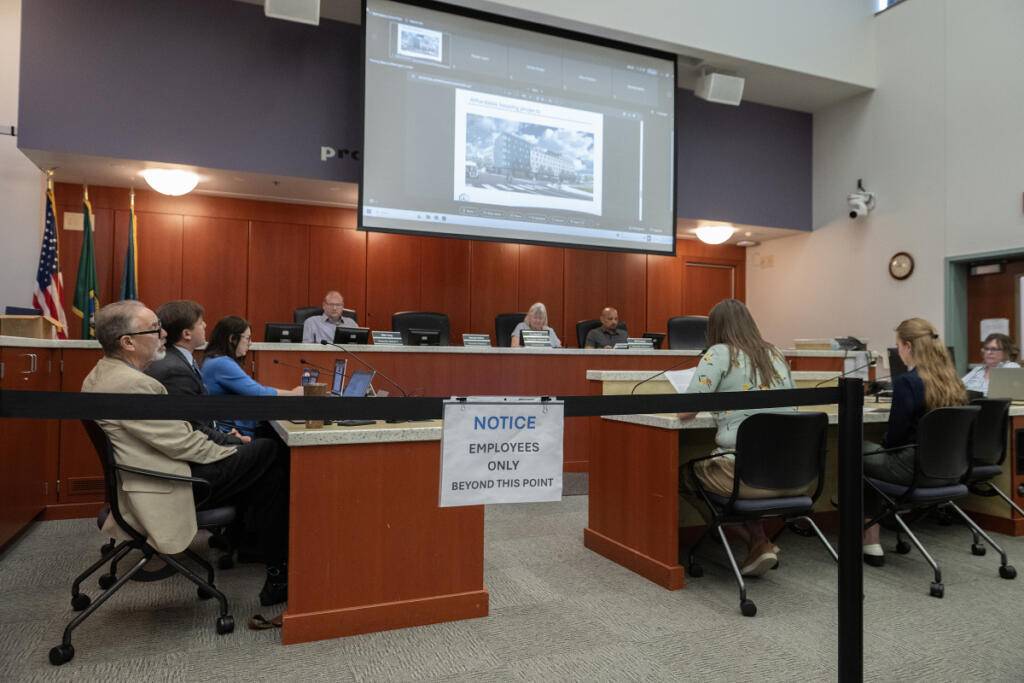
Clark County Public Health Director Dr. Alan Melnick, left, attends a meeting at the Public Service Center on June 24. The Clark County Council was hesitant to approve an increase in environmental public health fees for 2027 at last week’s Board of Health meeting. The county council serves as the county’s board of health. (Amanda Cowan/The Columbian files)

Clark County councilors last week expressed concern that fee increases proposed for health and safety permits would hurt business owners.

The county council, which also serves as the county’s board of health, considered the 2027 environmental public health fee schedule at a meeting July 22. The fees are for such services as onsite septic permitting, review of well applications, food establishment permits, school health and safety reviews, and pool and spa inspections.


A county directive prohibits using the general fund to pay for those activities, so the costs are passed on to residents in the form of fees.

Jeff Harbison, administrative services director for Public Health, presented two options to the council.

In the first option, fees would cover the full cost of services but cap the increase at no more than 5 percent for any individual fee. Public Health’s fund balance would be used to offset the difference between full cost of services and the revenue collected with the capped fee amount.

The second option would maintain all fees at the 2026 rate, except in situations where fees are set to decrease, such as in the food safety, drinking water protection and onsite septic operation and maintenance programs.

The fees that would decrease in this scenario would result in $87,173 less revenue for 2027. Public Health’s fund balance would be used to offset the difference between full cost of services and the amount collected from fees, including the revenue reduction.

Environmental public health fees increased 5.33 percent in 2024 and 11.69 percent in 2025.

According to the proposal, environmental public health fees are calculated to align with projected program expenses, such as labor costs for field and support staff, necessary operational supplies and equipment, mileage, overhead, benefits, and time spent in trainings and meetings.

When drafting the fee change proposals, county staff met with business owners. Many expressed that even a small increase in fees can impact their bottom line, said Gerry Preston, who oversees the county’s environmental health programs.

“Be it a hotel with a swimming pool, a restaurant or an elementary school, we heard and understand that they continually face financial strain and have multiple government fees to pay — not just Clark County’s fees,” Preston said.

Preston said the county’s environmental public health division is looking to other counties that have lower fees to see where Clark County might be able to lower costs.

Councilor Wil Fuentes said the biggest complaint he hears from small-business owners in the food industry is how much they pay in fees each year.

In the past, the council has informally voted to move forward with an option so an ordinance outlining the new fee schedule could be brought before the council in September for adoption. However, councilors didn’t settle on either of the two options presented and instead asked for a third to be drafted.

In this third option, fees would cover the full cost of services, but increases would be capped at 2 percent rather than 5 percent.

“I see both sides of the issue,” Councilor Glen Yung said. “We do need to maintain cost recovery. At the same time, everything is becoming a challenge and so expensive.”