Camas-Washougal logo tag

Germany keeps unsettling history of WWII, aftermath alive

By
timestamp icon
category icon Life
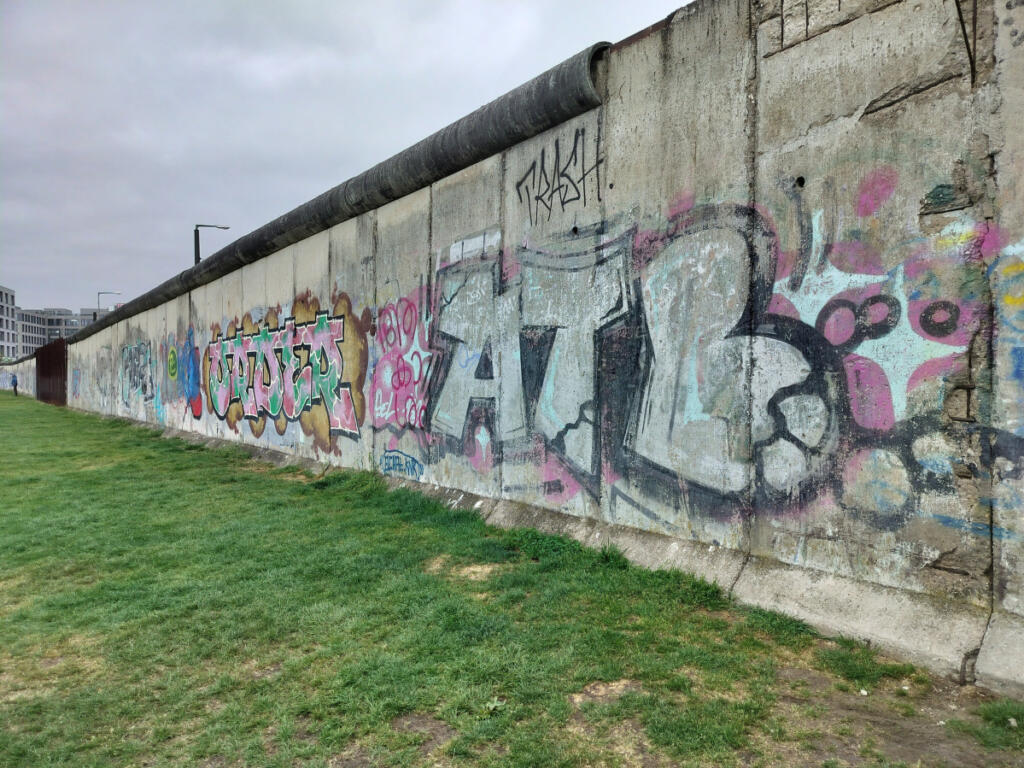
One section of the Berlin Wall remains standing near the Wall Memorial and museum in the northern part of the city. (Scott Hewitt/The Columbian)

BERLIN — A sprawling open-air artwork that occupies an entire city block here is designed to make you feel uncomfortable, overwhelmed and alone.

The artwork — situated on 4.5 acres of prime downtown real estate, surrounded on three sides by government and business buildings — is a vast grid of 2,710 irregular concrete slabs situated on a wavelike, rolling foundation. The open sides and sloping floor invite you to venture downward through mazelike corridors until the concrete slabs surround and submerge you. You can glimpse fellow visitors only in passing as they slip along adjacent corridors and quickly disappear — as if swallowed up by the darkness.

The eerie, unsettling site is called the Memorial to the Murdered Jews of Europe, aka the Holocaust Memorial, and it’s free to visit and open at all hours.

“It’s on a scale beyond our imagining. It’s deliberately disorienting, without any written guidance. It’s an abstract design with no words, because, what can you say?” said Ray Sun, an associate professor of history at Washington State University Pullman whose expertise is the Holocaust and how it is remembered and portrayed. “It says, ‘This is part of our history. It wasn’t an aberration. We cannot forget about this. We’ve got to make sure something better happens in the future.’”

I enjoyed the amazing opportunity to live in Berlin for two months this spring, and what struck me most forcefully about Germany’s capital city — after its extensive white-marble beauty, ubiquitous greenery and remarkably easy, convenient public transit — is the way its uniquely terrible, world-shaking history is kept on insistent, unflinching display. You can’t go far in Berlin without encountering a museum, monument or memorial recalling the horrors that occurred or originated here. Tourists interested in delving into the painful complexities of history will appreciate the way Berlin wrestles with tragic truths, keeping the very darkest chapters of human experience conscientiously alive.

A German “culture of remembrance” was enshrined as government policy in the 1990s, Sun said, and Holocaust education was made mandatory in German schools. But reaching that point was a long, painful process that took generational change and remains controversial to this day, he said.

“It was complicated and contentious and very political,” Sun said of Germany’s decision to exhibit its war crimes for residents, visitors and all the world. Germans who lived through the Holocaust were more interested in rebuilding their country and their lives than in wrestling with guilt and shame, he said. It was their descendants, who had no role in the Holocaust, who felt the keenest need to engage in some sort of public reckoning.

“Germany’s approach of coming to terms with its role in World War II and the Holocaust has changed over the years, ranging from an unwillingness to discuss and accept guilt to a very present culture of remembrance,” a
German government website
says. “The so-called ‘culture of remembrance’ … refers to the policy of confronting Nazi-era crimes through frank discussion and by acknowledging responsibility for the Holocaust. It has left its mark all across Germany, from large-scale government-funded memorials to small grassroots initiatives like … small engraved brass paving stones commemorating victims in the streets where they used to live.”

Those brass “Stolpersteine,” or stumbling stones, are ubiquitous in sidewalks throughout Berlin. They’re engraved with names, birthdates and other information about people who used to live onsite
— along with the date of deportation, final destination (that is, which concentration camp) and date of death. According to the project website, stones have been placed in 31 European countries —
chiefly Germany —
to date.

Motivating the project,
artist Gunter Demnig has written
, is the ancient Jewish saying that a person is not truly forgotten as long as their name is remembered.

It all seems to stand in stark contrast with the U.S. government’s current push to remove from national parks, museums and school curricula information it deems “divisive,” “inappropriately disparaging” of American pride or “fostering a sense of national shame.” That has included erasing information about slavery or violence against Indigenous peoples.

Here in Washington, the state historical society has launched a “Monuments Project,” aimed at correcting factual omissions or inherent racism on historical markers and monuments placed during the Jim Crow era. There have been two community-dialog sessions in Vancouver regarding
the so-called “Firsts” Monument on Officers Row
, which seems to claim that civilization and education didn’t begin here until white settlers arrived. But there’s been no determination that Vancouver’s “Firsts” monument —
or any similar marker in Washington —
should be revised, appended or retired from public view.

Markers and monuments may seem timeless, Sun said, but they always transmit attitudes of the times when they were installed — as well as the time that keeps passing. Security personnel and signs encourage proper, respectful behavior at the Memorial to the Murdered Jews, but they don’t prevent kids from playing tag and cuddly couples from snapping extremely out-of-context selfies amongst the solemn columns.

“Like any monument

it becomes part of the landscape,” Sun said. “I don’t think everybody always regards it solemnly as they go by. Some people simply view it as a nice open space.”

Block where it happened

The Memorial to the Murdered Jews of Europe, which includes a free underground museum, is just one of a network of related memorials to victims of Nazism that are all within walking distance in downtown Berlin. Those include memorials to homosexuals, people with mental and physical disabilities, “Sinti and Roma” people, and those who tried resisting Adolph Hitler — both politicians and typical German civilians.

A short walk from the main Memorial is another overwhelming city-block site called the “The Topography of Terror,” so named because it sits precisely where the masterminds of the Holocaust — military leaders, security and secret police, death-squad organizations — planned what they euphemistically called “The Final Solution” — the total destruction of all European Jews.

The Topography site is multifaceted. Outside is an open-air, below-ground panel display that provides a timeline of the rise of Naziism, the fates of its victims and the course of World War II. It also includes the eventual rise of the Berlin Wall, a section of which remains standing here. No longer standing are the buildings where Nazi officials made their evil plans. The Topography campus has been retained in a state of rubble and ruin, with no grass growing there.

Amidst the rubble is a free museum that conveys the same story in far greater detail, complete with agonizing photographs and a complete tour of European countries and populations that the Nazis invaded, terrorized and murdered. (An audioguide tour walks you through this difficult exhibit in about an hour.) Alongside the main exhibit when I visited was a smaller, temporary one exploring the attitudes of “typical German” citizens before and during World War II.

The Memorial and the Topography site are Berlin’s biggest, best-known monuments to its deadly past, but others abound. Outside one busy central city train station is a bronze sculpture of 10 children in two groups. One group symbolizes the 10,000 Jewish children whose lives were saved just before the war began via a British-led effort to ship them out of Germany. Facing away from them, the other group of five symbolizes the estimated 1.6 million Jewish children who were deported and murdered in concentration camps. The sculpture, by Frank Meisler, is called “Trains to Life, Trains to Death.”

On the west side of Berlin is a large, well-loved urban forest called the Grunewald — a popular destination for hiking, biking, picnicking and lake swimming. It’s an easy place for anyone to visit, thanks to a convenient metro train line that stops at the central trailhead. On one of my visits to the Grunewald, I chose the wrong staircase to reach my return train and wound up on a lonely platform that, I realized, had no train service.

What I found instead were steel plates naming the concentration camp destinations of 10,000 Berlin Jews who were deported from this station in 1941 and 1942. The “Platform 17 Memorial” is a quiet detour in a busy, active transit station.

Devil’s mountain

Naziism and the Holocaust are not the only horrors that Berlin keeps on prominent display. While hiking in the Grunewald, I randomly pointed myself toward a pair of radar dome structures atop a nearby hill and climbed a steep path to get there. I was astonished to discover yet another multifaceted historic site.

The hill is called Teufelsberg — “Devil’s mountain” — and an onsite museum tells its complicated story. The artificial hill is built out of rubble that was largely carted here by hand, shovel and wheelbarrow by everyday Berliners after their city was bombed into submission during the final days of World War II. A short U.S. Air Force film screening in the museum surveys the extensive destruction of Berlin as well as the rubble-clearing effort — which was mostly undertaken by women, because Berlin men were scarce after the war.

What followed the war was the end of the wartime “alliance of convenience” between the United States and the Soviet Union. The 400-foot Teufelsberg hilltop turned out to be an ideal site for eavesdropping on military communications between the Soviets and their satellites in East Germany and Poland, and radar “listening posts” were installed here in the early 1960s. (There also were ski lifts on the hill, but these were removed because they interfered with electronic surveillance.) Teufelsberg remained a key Allied listening post through the end of the Cold War.

There’s lots more to the Teufelsberg story. After the Cold War, a plan to develop luxury apartments on the hill fizzled. The abandoned buildings and radar domes became the targets of dedicated graffiti artists, and the site’s owner eventually relented about that popular activity. Today, Teufelsberg is a towering open-air street art museum that’s cloaked in many layers of sophisticated graffiti by renowned international artists of that style. (Strolling through Teufelsberg’s compact, single-floor historical museum is easy, but enjoying the art requires climbing the exterior fire-escape stairway of a large, empty concrete building. In addition to the art, there are terrific views of Berlin and its countryside.)

Much of the graffiti art at Teufelsberg is pointedly political and anti-establishment — and it’s on a jaw-dropping scale. You can’t help wondering: “How did the artists get all the way up there?”

Death strip

Graffiti also stands out on what’s left of the Berlin Wall, which was installed by the Soviets in the early 1960s in order to isolate West Berlin and stem mass emigration from east to west. During the Cold War between the Soviet Union and the United States, East Berliners (under Soviet domination) couldn’t even think about approaching the wall — but West Berliners made it into a DIY art canvas for their feelings of rebellion, individuality, outrage and yearning for a reunited city.

There are numerous places — including several different museums and walking tours — where visitors can touch and learn about the Berlin Wall and life behind the Soviet Iron Curtain. If Naziism is a heritage that Germans recall with humility and pain, it’s clear that they’re happy to celebrate the subsequent focus on freedom that generated unlikely escape strategies (like climbing over barbed wire, digging tunnels, and even attempting to outrun searchlights and snipers in the Wall’s heavily patrolled “death strip”) and uprisings. Eventually, that led to peaceful victory and a democratic society that strives to remember.

Scott Hewitt: 360-735-4525; [email protected]

Teufelsberg is a unique Berlin attraction: the small mountain built out of World War II bombing rubble housed a Cold War spy station before becoming today’s immense street-art showcase.
Teufelsberg is a unique Berlin attraction: the small mountain built out of World War II bombing rubble housed a Cold War spy station before becoming today’s immense street-art showcase. (Scott Hewitt/The Columbian) Photo
A display memorializes a few of the approximately 140 East Berliners who died trying to cross the Berlin Wall into West Berlin.
A display memorializes a few of the approximately 140 East Berliners who died trying to cross the Berlin Wall into West Berlin. (Scott Hewitt/The Columbian) Photo
One section of the Berlin Wall remains standing near the Wall Memorial and museum in the northern part of the city.
One section of the Berlin Wall remains standing near the Wall Memorial and museum in the northern part of the city. (Scott Hewitt/The Columbian) Photo
A section of the Berlin Wall still stands alongside Berlin’s Topography of Terror museum, which features a below-ground timeline of Naziism and World War II.
A section of the Berlin Wall still stands alongside Berlin’s Topography of Terror museum, which features a below-ground timeline of Naziism and World War II. (Photos by Scott Hewitt/The Columbian) Photo
Berlin’s Topography of Terror museum explores the rise of Naziism in Germany.
Berlin’s Topography of Terror museum explores the rise of Naziism in Germany. (Scott Hewitt/The Columbian) Photo
Thousands of “stumbling stones” (Stolpersteine) commemorating Jewish residents who were deported to concentration camps have been installed in streets all over Germany and other European countries.
Thousands of “stumbling stones” (Stolpersteine) commemorating Jewish residents who were deported to concentration camps have been installed in streets all over Germany and other European countries. (Scott Hewitt/The Columbian) Photo