Camas-Washougal logo tag

County parks system needs more money: ‘It’s pretty clear: The Clark County parks system is not meeting its existing needs’

County council hears options to address funding challenges

By
timestamp icon
category icon Clark County, Environment, News, Outdoors
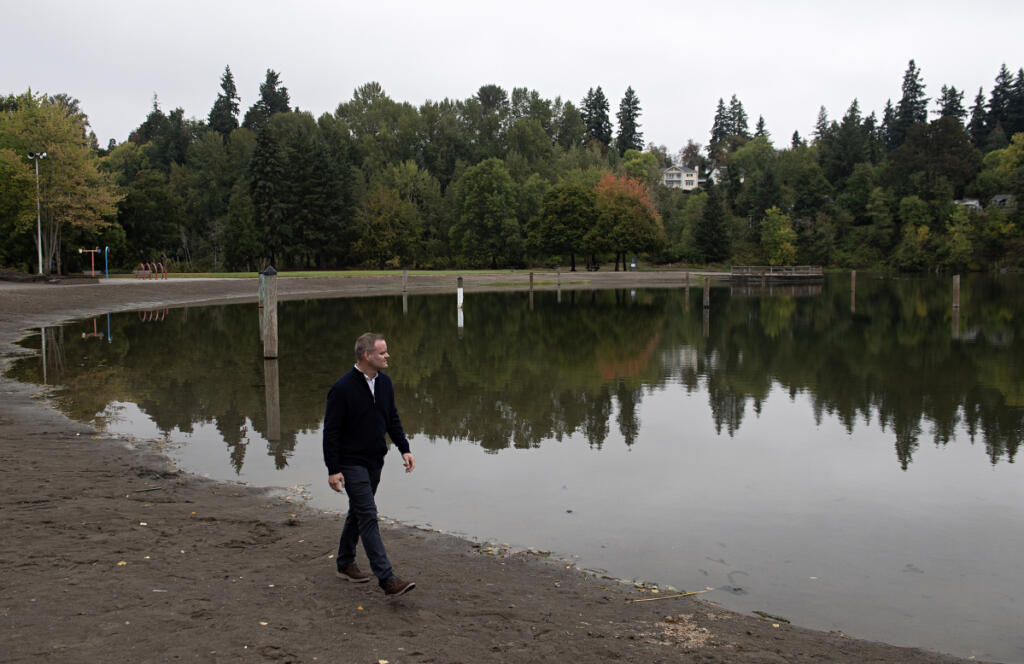
Ross Hoover, division director of Clark County Parks and Nature, takes a break at Klineline Pond on Oct. 3. Clark County’s big, diverse park system is woefully underfunded and falling farther behind all the time. Without a new game plan and new revenues, park closures and staff layoffs are on the horizon. (Amanda Cowan/The Columbian files)

Clark County will need to find additional funding sources — either through new fees, fee increases or other mechanisms — for the county’s 10 regional parks to remain open.

During a county council work session May 20, Ross Hoover, division manager for the county Parks and Nature department, said a lack of available funding, rising costs and rapid population growth are creating an untenable situation.

“It’s pretty clear: The Clark County parks system is not meeting its existing needs,” Hoover told the council.

During a March work session, the county council directed staff to work with the cities to get a better understanding of the funding challenges and explore potential solutions. Hoover said the team looked at park models used in other parts of the country experiencing the same funding gaps as Clark County.

For the past five years, the county has dipped into its reserve funds to cover basic services at the regional parks, but that’s not sustainable, Hoover said.

Although annual revenues have steadily increased since at least 2019, expenses have also increased, but at a greater rate.

“On the surface, this looks like we are simply spending too much,” Hoover said. “In reality, this is a function of bare minimum needs not being met by the revenue source.”

With the county already working with reduced staffing numbers, Hoover said there are no further ways to trim costs. Clark County has 0.69 full-time parks staff per 10,000 residents, compared with the national average of 3.6 employees per 10,000 residents for counties with a population greater than 500,000.

And because the number of staff working at parks has been reduced, Hoover said park upkeep has also suffered, with 33 percent of daily tasks left uncompleted and park maintenance deferred.

“It is extremely challenging to figure out how to reduce costs without significant impacts to communities and residents, to businesses, to park users,” he said, adding those cost reductions could include park closures.

According to data analyzed by the parks team, the cities are also underfunding and understaffing parks when compared with other parts of the country. Those gaps grew wider when compared with other parts of Washington.

Hoover said Clark County’s population is expected to reach nearly 720,000 residents by 2045, all of whom will want parks close to home. But with the funding issues and staffing gaps, the county will not be able to provide those services at the level people will expect, he said.

Funding options

Hoover said the team identified two possible revenue sources for the county council to consider. The first would be a regional levy similar to one in King County that would benefit both county and city parks and require voter approval. Prior to passing the regional levy, he said King County was in similar financial straits and had already closed some parks.

The second, and preferred, option would be the creation of a metropolitan park district. As defined by state law, metropolitan park districts generally offer greater fiscal capacity and flexibility than park and recreation districts. Metropolitan park districts only require approval by a simple majority of voters, after which the park district’s legislative body can impose permanent property taxes. Park and recreation districts can only impose property tax levies for six years at a time and require 60 percent voter approval.

If that sounds familiar, that’s likely because Clark County already passed a metropolitan parks district, the current Greater Clark Parks District, with a property tax rate of 27 cents per $1,000 of assessed value.

Hoover said the current rate has dropped to about 14 cents per $1,000 of assessed value, generating around $4.5 million in revenue annually. If the district boundary were expanded to include the entire county, property tax revenues would be around $15 million annually.

“It could be utilized specifically for parks in the county and for local city park systems,” he told the council.

Expanding the existing district boundary would require voter approval. If the county council moves forward with the idea, a measure would likely be placed on the ballot in 2027.