Camas-Washougal logo tag

Vancouver Audubon celebrates its 50th anniversary

Nonprofit's local chapter works to protect bird species and their habitat

By
timestamp icon
category icon Clark County, Environment,

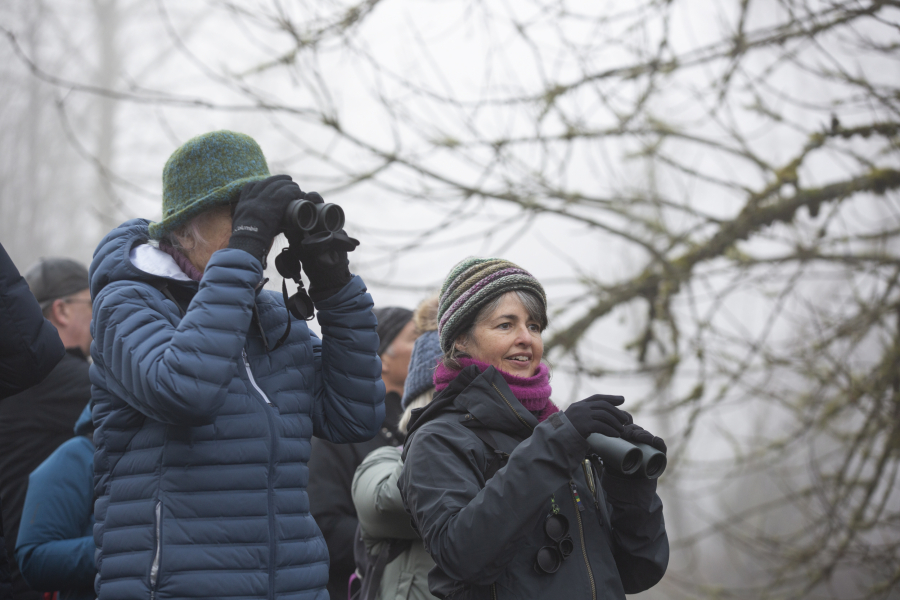
For members of Vancouver Audubon Society, most days are for the birds — more precisely, finding and identifying birds, educating others about birds and protecting birds.

On Tuesday, the nonprofit group will celebrate the 50th anniversary of its founding in December 1975 with a celebration following its regular monthly meeting.


The Vancouver chapter is one of 24 in Washington and more than 400 nationwide. Much has changed since 1975. Bird habitat has decreased significantly as Clark County’s population increased nearly fivefold, and smaller cities like Ridgefield and Battle Ground have added thousands of new homes.

One thing hasn’t changed: Vancouver Audubon’s mission to protect and conserve bird species through education, advocacy, recreation and stewardship.

“We need to educate people more about all the different species and habitat and what’s going on and what we can do. The more we talk about it, the more we put it in our newsletter, the better,” said Joan Durgin, who serves on Vancouver Audubon’s board of directors.

Tom Tinsley, president of the Vancouver chapter, has been a longtime birdwatcher but joined Vancouver Audubon only in 2022, after his retirement. He became a member of the local chapter soon after moving to the area.

“We bring to the table an opportunity to engage and educate the public as it relates to birds, their habitat, conservation issues, and things that better not only birds but all wildlife and ourselves,” Tinsley said.

Protecting birds and their habitat benefits more than just the birds themselves, said Susan Saul, the Vancouver chapter’s conservation director.

“There’s a lot of reasons to conserve birds besides just their intrinsic value as part of the ecosystem,” she said. “There’s a lot of human connections to birds. For a lot of people, that’s their gateway to nature.”

Saul has been a member since the chapter’s founding. She said she showed an interest in birds at a young age.

“In my baby book, my mom wrote that my first sentence was ‘Birds all gone.’ We had a big picture window in the living room of our house … and I learned that if I banged on the window with my hand, the robins would all jump up and fly around,” she said. “I guess I was a birder from my first sentence.”

Saul said she’s thankful the Vancouver chapter benefits from the support of the state and national organizations but isn’t constrained by either.

“We decide how we’re going to spend our money, who we’re going to invite to be speakers, what we’re going to put in our newsletters. All of that is all totally driven at the local level. I really like that autonomous model for conservation,” she said. “When we have conservation issues down here that don’t fit into the Audubon Washington agenda, we just do our thing.”

Saul said the big push now is to reverse the “bird curve,” the loss of 3 billion birds since 1970 that studies show is mostly due to habitat loss.

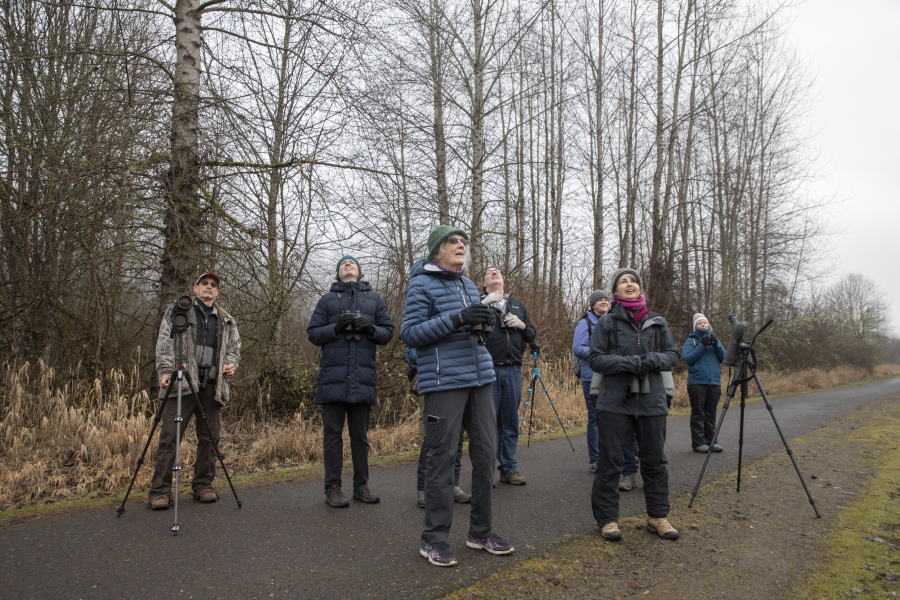
As a frequent leader on bird walks and field trips, Saul and others share their years of experience with others new to the hobby. Saul said the programs and classes Vancouver Audubon offers, including bird walks on the first of the month and field trips, are always free, something especially important now as parents often struggle to find affordable activities for their kids.

“We’re flexible. If you can’t start at 7 a.m., your second grader can’t get ready in time, you can come at 8 a.m., and we’re still probably just right down the trail,” Durgin said.

You also don’t have to be a bird expert or seasoned birdwatcher to join an activity. Tinsley said the group is for all levels of interest and experience.

“Birders are anyone, from someone who has a book and stares out the kitchen window to someone who spends five or six days a week afield looking for birds in Southwest Washington and beyond,” he said. “Whether you do it while you’re sitting at the kitchen table looking out the window or you get in your car and you drive at O-dark-30 in the morning to be at a location by sunup … they’re all birders.”

Southwest Washington is home to renowned birdwatching locations, including Ridgefield National Wildlife Refuge and Steigerwald National Wildlife Refuge. Durgin said she even gets asked about the Ridgefield refuge when she travels to other parts of the country.

“We have some very good trail systems in Clark County, many of which are managed by the Clark County Legacy Lands Department. The Salmon Creek greenway comes to mind as one of those. We are fortunate in that respect,” Tinsley said. “In Southwest Washington, we are accessible to the coast and the shoreline, which brings with it a whole different set of birds at certain times of the year.”

However, Clark County has its challenges when it comes to balancing development and employment growth against the conservation of wildlife and wildlife habitat, Tinsley said.

“Another challenge that is global … is climate change. Climate change is here, and it’s here to stay,” he said. “We see challenges with that in terms of giving certain species a reduction in their distribution or an expansion in their distribution as it relates to climate change.”

There is one thing about Vancouver Audubon that hasn’t changed: its name. Recent controversy over Audubon Society founder John James Audubon’s historical racism and ties to slavery has led some chapters to change their name, including Portland Audubon, which is now Bird Alliance of Oregon. The national organization’s board of directors voted to keep its name in March 2023, stating that it represents much more than the work of one person and that keeping the name will allow members to focus on its mission to protect birds. Discussions at Vancouver Audubon are ongoing.

“I believe there’s roughly 25 percent of the chapters in the state that have either changed their names or are in the process of considering a name change,” Tinsley said. “Nationally, I believe, roughly 12 percent of the 400-plus (nationwide chapters) have either changed their names or are considering a name change.”

Durgin remains focused on conservation and protecting birds and bird habitat.

“I think we need to keep on reminding people what’s going on and why,” Durgin said. “Let’s do something.”