Camas-Washougal logo tag

C-Tran committee supports 3-3-3 board makeup

State warned transit agency that composition violates law, jeopardizes grant funding

By
timestamp icon
category icon Camas, Clark County, Government, Washougal
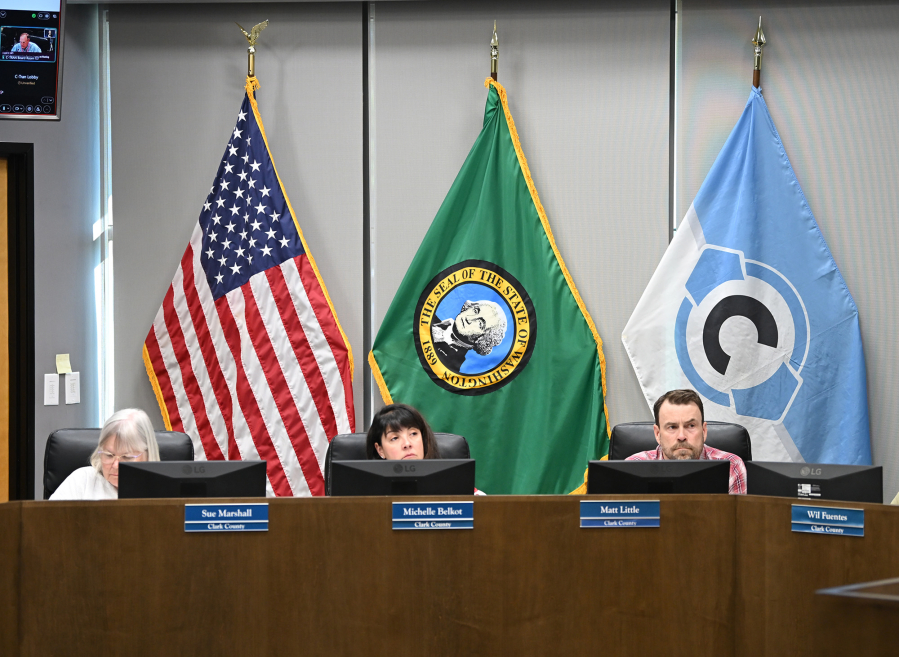
C-Tran Board Composition Review Committee members Sue Marshall, from left, Michelle Belkot and Matt Little listen to public comment Aug. 12 during a meeting at the transit agency’s headquarters in Vancouver. (Taylor Balkom/The Columbian files)

Officials representing Clark County’s small cities on a committee revising the composition of C-Tran’s board of directors are willing to risk millions of dollars from the state if it means they get more representation.

On Wednesday, the committee, which includes six representatives from the small cities, four from the Clark County Council and one from the city of Vancouver, voted 8-3 in favor of a “3-3-3” plan that would give the small cities, county and city of Vancouver an equal number of seats on the transit agency’s board.


In June, the Washington State Department of Transportation sent a letter to C-Tran officials telling them that C-Tran’s board is not in compliance with a state law requiring a population-based representation on transit agency boards. The state said the city of Vancouver and Clark County are underrepresented on C-Tran’s board while the region’s smaller cities are overrepresented.

The current C-Tran board has three seats for the city of Vancouver, two seats for unincorporated Clark County and four seats for the small cities, including one seat each for Battle Ground, Camas and Washougal and another seat representing the cities of Ridgefield and La Center and the town of Yacolt.

The state transportation department has said a true population-based board would have four seats representing Vancouver, three seats representing Clark County and two seats reserved for the small cities.

The state has warned if the C-Tran board does not come into compliance by Oct. 1, the agency may be ineligible for millions of dollars in state grants.

On Aug. 12, the composition review committee voted to move forward with its 3-3-3 plan and said that if the state did not approve of its alternative plan, it would consider the suggested “4-3-2” board configuration.

In the weeks since that Aug. 12 meeting, officials in Camas have suggested they would sever ties with C-Tran, and Ridgefield officials said they would look into legal remedies if the small cities have two instead of three seats on the C-Tran board.

On Aug. 28, Molly Hughes, the state’s interim public transportation director, wrote to the composition review committee and said the 3-3-3 plan does not comply with state law.

“WSDOT does not agree with the board’s analysis and does not believe any application beyond a plain reading of RCW 36.57A.050 is necessary to bring the board’s composition into compliance with the statute,” Hughes said in the letter.

Get the latest headlines in your email every week!

This field is for validation purposes and should be left unchanged.

Hughes noted that the small cities represent 18 percent of the population served in C-Tran’s benefit area while unincorporated Clark County represents 38 percent and the city of Vancouver represents 44 percent.

“Applying a plain reading of the statute based on these population percentages, WSDOT does not believe that a 3-3-3 composition of the board complies with the statute’s requirement for ‘proportional representation, based on population,’ ” Hughes said in her letter.

‘Risk is too great’

On Wednesday, after meeting in a private executive session for more than 45 minutes, the board composition review committee members voted on a motion to stick with the proposed 3-3-3 plan even if it means risking millions of dollars in state grant funding.

Vancouver Councilor Erik Paulsen and Clark County Councilors Wil Fuentes and Sue Marshall voted against the motion.

“I won’t be supporting this motion and not for the obvious reason, which is that the other alternative would favor my jurisdiction,” Paulsen said. “My thinking is more informed by risk versus reward.”

Paulsen said he was not willing to risk losing state grant funding to make the 3-3-3 plan work.

“There’s just a tremendous amount of money that would be lost,” Paulsen said.

Marshall agreed.

“I think the risk is too great for C-Tran and its ridership,” she said.

The motion that passed Wednesday included a request that WSDOT temporarily suspend C-Tran grant funding decisions until the issue of board composition can be resolved.

Unfair advantage?

The committee’s small city representatives argued Wednesday that giving the city of Vancouver four seats and Clark County three seats on the C-Tran board would effectively mean one jurisdiction — Vancouver — would have a majority vote on the board, something the officials suggested would also violate state law.

The county council’s Districts 1, 2 and 3 overlap with the city of Vancouver and its urban growth area. That means county councilors would vote with Vancouver on issues that often divide the urban and suburban areas, including extending TriMet’s light rail trains across the Interstate 5 replacement bridge, small city officials said.

In a letter sent to the composition review board Tuesday, Ridgefield Mayor Matt Cole said he believed the state’s suggested 4-3-2 board composition would result in “representation by population” for the city of Vancouver and would also jeopardize C-Tran’s state grants by having “single city representation” on the board.

Cole said in the letter that, if the composition review committee were to adopt the state’s recommended 4-3-2 configuration, the city of Ridgefield would immediately begin to evaluate its legal options.

Fuentes and Marshall countered the suggestion that they would vote in the city of Vancouver’s interests while representing the county on the C-Tran board.

“I’m not really sure where this notion that the city of Vancouver would have the majority vote (came from) when, although I do represent District 3, which is east Vancouver, as a councilor, I am representative of the county as a whole,” Fuentes said. “I don’t represent the city of Vancouver. I represent the county.”

Clark County Councilor Michelle Belkot, who is involved in a legal battle to be reinstated on the C-Tran board, said she agreed that Vancouver would have an effective majority as long as county councilors representing Vancouver-area districts were on the C-Tran board, but Marshall wasn’t convinced.

“I would like to get a legal opinion on that because I think it’s a stretch,” Marshall said.