Camas-Washougal logo tag

Invasive emerald ash borer likely on way to Clark County

Officials say the pest has been discovered in Portland and is likely to cross Columbia River within two years

By
timestamp icon
category icon Environment, News
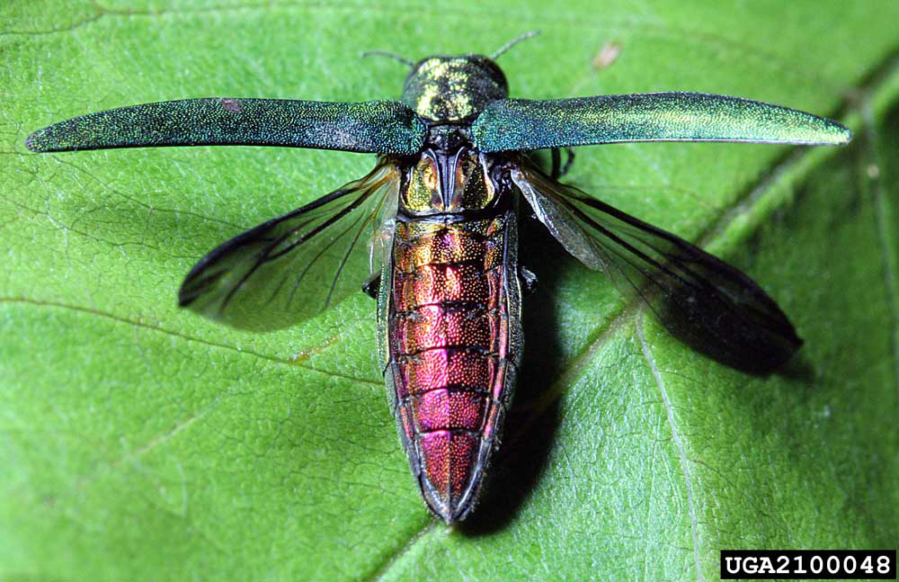
The emerald ash borer, an invasive species of beetle, has been found in Portland. Local officials say it’s only a matter of time before the pests, which hollow out and kill ash trees, will arrive in Clark County. (Contributed photo)

Oregon forestry officials recently announced that invasive emerald ash borers have been found in six new locations in the Portland area and warned a widespread infestation is on the way.

The beetles have yet to be spotted in Washington, but that may be about to change.

“With it being found in Portland now, it does just seem like a matter of time,” said Ryan Savaikie, lead forester for Clark Conservation District.

The bright green beetles, often referred to as EAB, bore through ash trees, killing them. The beetles are responsible for the loss of millions of ash trees across the Midwest.

The city of Vancouver’s urban forester, Charles Ray, said Oregon’s latest model shows the invasive species will arrive in Washington within two years. Local and state agencies aren’t waiting for that to happen before taking action. Clark Conservation District, Vancouver, the Washington State Department of Natural Resources and others have already begun taking steps to replace ash trees with other tree species.

“When we met with Washington Department of Agriculture shortly after it was identified in Forest Grove in 2022, they stated, ‘Act like it is here, it is only a matter of time,’ ” Ray said. “I took that to heart.”

He said the city began implementing a management plan in 2022.

Many of the ash trees found in Vancouver and Clark County are Oregon ash trees. Ray said they are an important native species often found along creeks, rivers and wetlands where they stabilize riparian habitat. The ash trees also provide habitat for wildlife. Oregon ash and other ash species can be found throughout Vancouver, Ray said.

“Vancouver’s tree inventory identified less than 500 individual ash trees on public property, which is 4 percent. However, the tree inventory is only a partial inventory and does not include all street trees or any natural areas, nor ash trees on private property,” he said.

Green ash and white ash have been reliable, tough, urban-tolerant shade trees, which made them ideal for parking lots, along streets and in backyards, Ray said.

Thomas Kyle-Milward, communications manager for DNR, said the state agricultural office had previously conducted small-scale emerald ash borer trappings, but the program ended after the insects were federally deregulated in 2021. He said DNR has hosted workshops aimed at raising awareness about emerald ash borer and helping communities prepare for its inevitable arrival.

He said the forestry program encourages communities to inventory their ash trees, develop response plans and consider potential management options, such as chemical treatment, biocontrol, or removal and replacement with other species.

“DNR also emphasizes the importance of not moving firewood, since this practice accelerates the spread of invasive pests,” he said.

Kyle-Milward said DNR tree plantings are done after responding to fires and don’t include ash trees. He said most of the plantings are in Eastern Washington or at higher elevations outside of the trees’ range.

Additionally, he said DNR’s Urban and Community Forestry Program does not support plantings of ash species through its grant program or other direct investments and recommends their removal from city- and county-approved tree planting lists.

The invasive species council asks Washington residents to report any emerald ash borer sightings through its website or mobile app. Kyle-Milward said every report submitted is reviewed by a qualified professional.

Shari Phiel: [email protected]; 360-562-6317; @Shari_Phiel

About the project: Community Funded Journalism is a project from The Columbian and the Local Media Foundation that is funded by community member donations including The Cowlitz Tribal Foundation. The Columbian maintains editorial control over all content. For more information, visit columbian.com/cfj.