Camas-Washougal logo tag

Copters carry logs into river for salmon

Wood will slow water, offer protection for fish

By
timestamp icon
category icon Clark County, News, Outdoors
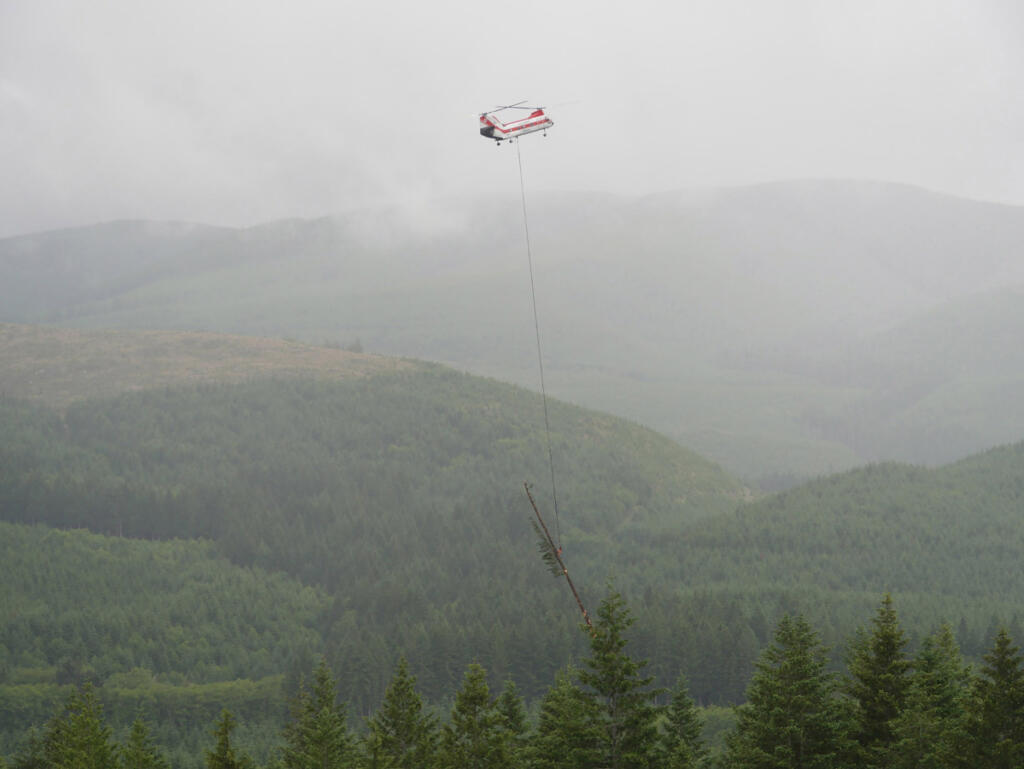
A helicopter flies along the South Fork Toutle River valley to carry a large log to the Lower Columbia Fish Enhancement Group’s salmon habitat-restoration project. The group has placed hundreds of logs in and along the South Fork Toutle River in recent years. (Contributed by the Lower Columbia Fish Enhancement Group)

TOUTLE — The whomp-whomp-whomp of helicopter blades carried for miles across the South Fork Toutle River valley last week as crews from Oregon-based Columbia Helicopters carried logs from a timber harvest upstream to a salmon habitat-restoration project.

“It’s a pretty high-priority watershed for a lot of species,” said Steve Manlow, executive director of the Lower Columbia Fish Recovery Board. “All the species are (Endangered Species Act)-listed here, and it’s one of those watersheds where you have both fall chinook and spring chinook, you have winter steelhead, summer steelhead, Coho and chum. There aren’t a lot of watersheds that have all the listed species.”


The Lower Columbia Fish Enhancement Group took advantage of the warm weather and dry conditions to begin the next phase of its work restoring Toutle River habitat.

That work includes diverting the single-channel river into side channels where appropriate, planting native plants and trees like cottonwood and willow, and placing woody debris in and along the river.

The wood slows the water and provides hiding spots for juvenile salmon and other aquatic species. It also helps spread the river across the floodplain.

The group had to figure out how to bring the 25-foot, 30-foot or longer logs and large root ball structures to the remote location. Rather than carrying the wood over land, which would be difficult, the Lower Columbia Fish Enhancement Group purchased a 78-acre timber harvest, at a cost of more than $2 million, from a Washington Department of Natural Resources public sale. The harvest site sits about a mile downstream from the restoration work currently in progress.

Over a three-week period, the helicopters will make more than 100 trips a day to bring the 2,000 to 3,000 logs to the site.

“What we’re doing is going back in and putting those wood structures in there, using the helicopter to carry the wood in and kind of resetting the river to where it was post-eruption — full of logs but in a more controlled and engineered way,” said Morgan Morris, executive director of the Vancouver-based fish enhancement group.

If the group had to purchase the timber elsewhere and bring it to the site, the cost would have been closer to $4.6 million, Morris said.

“We needed to win the sale,” she said. “We got it for what we thought was a fair price.”

While the South Fork Toutle River may not have the same obstacles for fish passage as the north fork, which was clogged by the 1980 eruption of Mount St. Helens, that doesn’t mean restoration work isn’t needed.

“Following the eruption, there was a salvage logging operation that took all the logs out of the system. What was left was just the lahar (a fast-moving debris flow), and the river has been kind of flowing back and forth from valley wall to valley wall and preventing any riparian or fish habitat from establishing,” Morris said.

The Lower Columbia group is one of 14 nonprofit organizations that make up the Regional Fish Enhancement Group, created by the Legislature in 1990. The group works with communities across the state to recover salmon through partnerships with local, state and federal agencies, tribes, local businesses, community members and landowners. Each group is a separate nonprofit working within a geographic region based on watershed boundaries and led by a board of directors.

To ensure the project could move forward, Morris said, the group has been working with timber giant Weyerhaeuser. She said these relationships are key to the nonprofit’s work being successful.

“Between 70 and 80 percent of the region is either industrial, state or federal forest land,” she said. “With that much of the stream network on forest lands, it’s really important to be working cooperatively with DNR and the property owners.”

Shari Phiel: [email protected]; 360-562-6317; @Shari_Phiel

A skidder is used to place a log in the South Fork Toutle River in July 2025. The Lower Columbia Fish Enhancement Group is continuing its salmon habitat-restoration work this year, using helicopters to bring 2,000 to 3,000 logs to the site.
A skidder is used to place a log in the South Fork Toutle River in July 2025. The Lower Columbia Fish Enhancement Group is continuing its salmon habitat-restoration work this year, using helicopters to bring 2,000 to 3,000 logs to the site. (Contributed by the Lower Columbia Fish Enhancement Group) Photo