Camas-Washougal logo tag

Data: Immigration arrests in Clark County were among highest in state last year

County experienced 132 arrests, or 25 arrests per 100,000 residents, in 2025

By
timestamp icon
category icon Clark County, Government, News
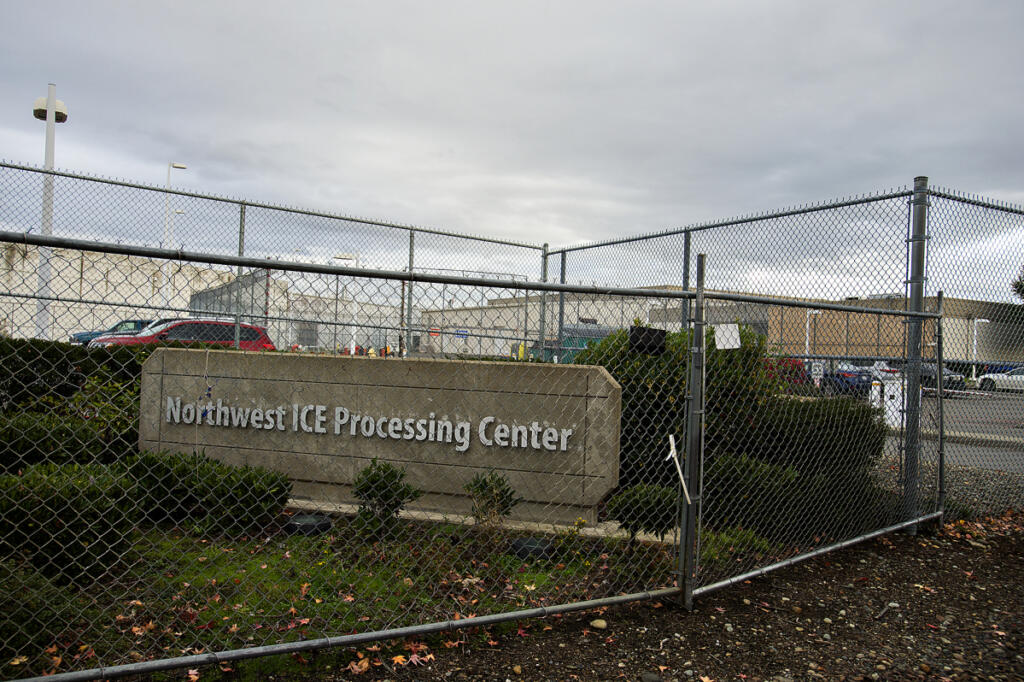
The Northwest ICE Processing Center is pictured in Tacoma on Oct. 25, 2019. (Amanda Cowan/The Columbian files)

Newly compiled data reveals how federal immigration agents executed a historic surge of warrantless street arrests last year across the Pacific Northwest, including in Clark County.

The University of Washington Center for Human Rights released data last week detailing the magnitude of the surge fueled by bypassing Washington privacy laws to access local drivers’ personal information.

The U.S. Department of Homeland Security calls the crackdown “Operation Black Rose” internally. It resulted in nearly 2,250 immigration arrests across the Northwest between October and December.

In Washington, federal immigration officials made about 2,340 arrests last year. Statewide arrests jumped from fewer than 100 in January 2025 to more than 350 in December.

According to the university’s dataset, Clark County experienced one of the highest increases in arrests across the state last year, joining King and Yakima counties as the epicenters for Washington’s enforcement surge.

Last year, Clark County saw 132 arrests, or 25 arrests per 100,000 residents. By comparison, in 2024, the county saw 14 arrests, or about 2.7 per 100,000 residents, and in 2023, 15 arrests, or 2.9 arrests per 100,000 residents, the data shows.

Neighboring Multnomah County in Oregon recorded the region’s most intense concentration with 770 arrests, or 96.7 arrests per 100,000 residents last year. Of those arrests, 576 were during the final three months of the year, according to the data.

But Clark County’s position along Interstate 5 leaves daily commuters exposed to the exact same Border Patrol license plate queries that fueled the massive sweeps directly across the river.

“I think we are seeing the predictable human rights and civil rights impacts of a campaign of mass deportation,” said Phil Neff, research coordinator for the UW Center for Human Rights.

U.S. Immigration and Customs Enforcement, the Department of Homeland Security and U.S. Customs and Border Protection did not respond to requests for comment from The Columbian.

Neff said researchers used data from the Deportation Data Project, which has incomplete information from other parts of the country, making regional comparisons difficult.

The new dataset compiles information from I-213 forms, which document the initial apprehensions of individuals identified as deportable by immigration enforcement agencies. The resulting enforcement surge pushed regional immigration detentions to levels not seen since the Obama administration, according to the dataset.

Neff said the new dataset is an undercount of actual arrests.

“We think that this data is only about 60 to 85 percent of the total number of arrests in a given time period for 2025,” he said.

Sweeps

State lawmakers intended the 2019 Keep Washington Working Act to prevent state agencies from assisting civil immigration enforcement targeting residents based on race, religion or immigration status.

However, a January report from the UW Center for Human Rights found federal agents are using a data-sharing system as a loophole to pull Washington State Department of Licensing records and initiate rapid street-level apprehensions.

Court documents from UW’s Roadside Assist report reveal agents use a national switchboard called Nlets that runs through the Washington State Patrol’s interface. While the state blocked ICE from pulling state licensing data late last year, it left access open for Customs and Border Protection, which Neff said is responsible for the majority of the queries in civil immigration enforcement.

Researchers documented multiple cases where Border Patrol agents ran license plate searches on behalf of joint federal arrest teams operating deep within the state.

Neff said the law is clear. Washington agencies cannot use resources to assist federal enforcement targeting residents based on race, religion or immigration status.

Transcripts from a recent evidentiary hearing in U.S. District Court in Oregon detail the field tactics used during these sweeps. During a December hearing for a class-action case, federal agents testified that out-of-state teams deployed to the region operated under daily arrest quotas to meet national administration goals

Agents described using predictive surveillance software from Palantir called the ELITE app to cast dragnets over neighborhoods with high statistical probabilities of housing undocumented immigrants, referring to agricultural towns as “target rich,” court records show.

The app is described in court testimony as “kind of like Google Maps” that shows how many people in the area have had some kind of contact with immigration officials, including naturalized citizens. They also used a mobile application called Mobile Fortify to run real-time facial recognition scans on people detained in the field.

According to court documents, instead of arriving with warrants for specific individuals, masked agents staked out parking lots, agricultural worksites and commuter routes.

Neff said fear of federal immigration enforcement has a compounding effect on local economies and social life, leading people to reduce spending, attend fewer events, and limit their participation in work or school.

“I hope this dataset lets people in the Pacific Northwest see that this kind of enforcement shows a series of violations of civil liberties and due process rights,” Neff said. “Those violations should concern everyone. It should be concerning that the federal government can illegally detain people the way they have been.”