Camas-Washougal logo tag

‘This allows us to move forward’: I-5 Bridge program’s Supplemental Environmental Impact Statement complete

By
timestamp icon
category icon Clark County, Government, News
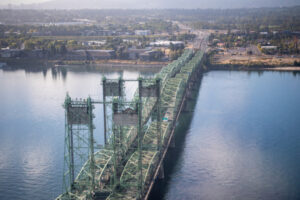
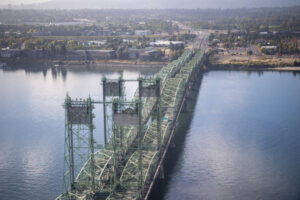
The Interstate 5 Bridge crosses the Columbia River on Oct. 11, 2022. (Taylor Balkom/The Columbian files)

The Interstate 5 Bridge Replacement Program has reached a critical step in its process and could receive final approval from the federal government by summer.

On Feb. 4, Carley Francis, the program’s interim administrator, told the Southwest Washington Regional Transportation Council that the program’s final Supplemental Environmental Impact Statement is complete and ready to be signed by the program’s joint agencies in Washington and Oregon.

Publishing that report is the final step on the path toward receiving an amended record of decision from the federal government, Francis said.

“That allows us to move forward with construction,” she added.

10,000 comments

The bridge replacement program closed its 60-day public comment period on the draft environmental report in November 2024 and received nearly 10,000 comments, including nearly 3,000 comments about how the proposed bridge designs might impact drivers, pedestrians, bicyclists, transit users and freight traffic. Other comments touched on specific design elements such as a shared-use path, plans to have light rail crossing the new bridge, seismic improvements and previously dismissed options like building a third bridge east of the Interstate 205 Bridge or tunneling under the Columbia River.

Matt Ransom, the regional transportation council’s executive director, told his board Feb. 4 that the final environmental report answers all of the comments submitted by the public in 2024. All that’s left is to sign it, he said.

After the joint agencies, including C-Tran in Washington and TriMet in Oregon, sign the document, the decision will be in the hands of the federal government.

“Our role is to submit the document for approval,” Ransom said.

Ransom said the federal agencies are expected to give their final approval and issue a record of decision this spring or summer.

“But we don’t know how the feds may act or how quickly they may act,” he said.

‘Costs are shifting’

Program staff are still working to update the estimated cost of replacing the I-5 Bridge, Francis said Tuesday.

Documents shared with The Columbian in early January showed that the final cost could be more than double the program’s current $6 billion estimate.

“The ability to contain costs that are going up across the construction industry is not in our capacity,” Francis said. “We have seen other projects … go up 35 to 65 percent. And material costs are increasing. So, there is just the reality that those costs are shifting.”

She said the U.S. Coast Guard’s recent approval of the program’s preferred fixed-span bridge design should help keep some costs in check.

“We are very pleased with that outcome and decision,” Francis said. “It does have significant cost savings.”

In 2022, the program estimated that it would cost an additional $500 million to build a moveable-span bridge instead of a fixed-span bridge.

“And that was not risk-loaded, not escalated to year of construction,” Francis said. “So that’s a very base number (and would be) significantly higher when you start to think about when that would occur in time and the risks associated with building that moveable structure.”

Get the latest headlines in your email every week!

This field is for validation purposes and should be left unchanged.

Francis said the Coast Guard’s decision is informing the new cost estimate.

“This key decision is really critical, and we’re factoring it into the best ways to think about moving forward with this program within the funds that we have,” she said.

Francis said the bridge replacement project will likely be done in phases based on available funds. The most important elements of the program, including building a multimodal and seismically sound replacement bridge, will take top priority and other elements will wait for additional funding.

“The commitment of the states is to work over time to bring that full 5-mile program to fruition,” Francis said.

The bridge replacement program’s revenues include $1 billion each from the states of Oregon and Washington, $2.1 billion in committed federal funding, up to $1.6 billion from tolling and another $1 billion the program is requesting from the federal government.

Sen. Patty Murray, D-Wash., has also secured an additional $100 million to build light rail on the replacement bridge.

In an emailed statement, Murray said her “commitment to the I-5 Bridge replacement project is unshakeable.”

“And I am proud to secure $100 million to support light rail for this critical project — building light rail here will greatly improve connectivity between Vancouver and Portland, delivering a major win-win for Southwest Washington and Oregon,” Murray said.

Amid rising cost estimates for the project, Republican Rep. John Ley, who represents Washington’s 18th Legislative District, recently introduced legislation that would require an independent performance audit of the bridge replacement program.

Ley said his proposed House Bill 2669 is “about accountability, transparency and making sure we get the best return on investment.”

“With a project of this size and cost, taxpayers deserve clear answers about how their money is being spent and whether the decisions being made will actually deliver the congestion relief that’s been promised,” Ley said in a news release.

Francis said the program has deadlines attached to its federal funding and needs to obligate nearly $1 billion by the end of September.

Program leaders expect to release a new bridge replacement cost estimate in March, she said.

“We know everybody is very interested in getting that information,” Francis said, “so we are working to get it out as soon as possible.”