Camas-Washougal logo tag

Recent storms reshaped ecosystems: Gifford Pinchot saw more than 16 inches of rain in early December, raising risk of mudslides

By
timestamp icon
category icon Clark County, Environment, Outdoors

Recent storms that brought heavy rains to Southwest Washington left behind a swath of environmental damage from Randall and Packwood along the Cowlitz River to several county parks along the Lewis and East Fork Lewis rivers.

Downed trees can disrupt nesting birds and other wildlife. Slides also can lead to habitat loss, and younger animals may not be able to escape rising water levels. While all that water running into local rivers might seem ideal for fish, that’s not necessarily the case.

“Large storms, like those in the recent week, are largely beneficial to ecosystems, though they can be detrimental to some salmon in the short term,” said Erinne Goodell of Lower Columbia Estuary Partnership. “In the short term, redds that were laid in the fall can get washed out or covered in silt. That’s especially true for salmon that spawn in the lower reaches of the river.”

Goodell said not all salmon species are currently spawning. Some, such as steelhead, spawn in the spring. Chum spawn in the fall and winter. Chinook have runs in the spring, summer and fall. And coho peak in the fall.

“One other negative impact is that some fish can become stranded in high-water areas when the flood waters recede,” she said.

According to the U.S. Forest Service, the Gifford Pinchot National Forest saw more than 16 inches of rainfall in early December.

“This rapid increase in rainfall has resulted in localized flooding in surrounding communities and has increased the risk of landslides, debris flows and downed trees across the forest,” according to an agency news release.

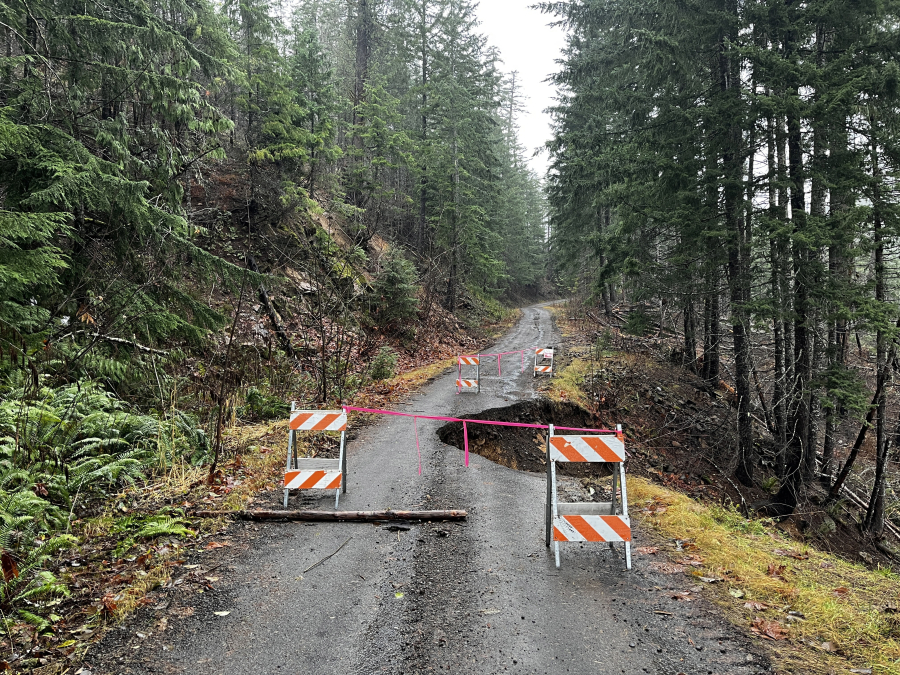
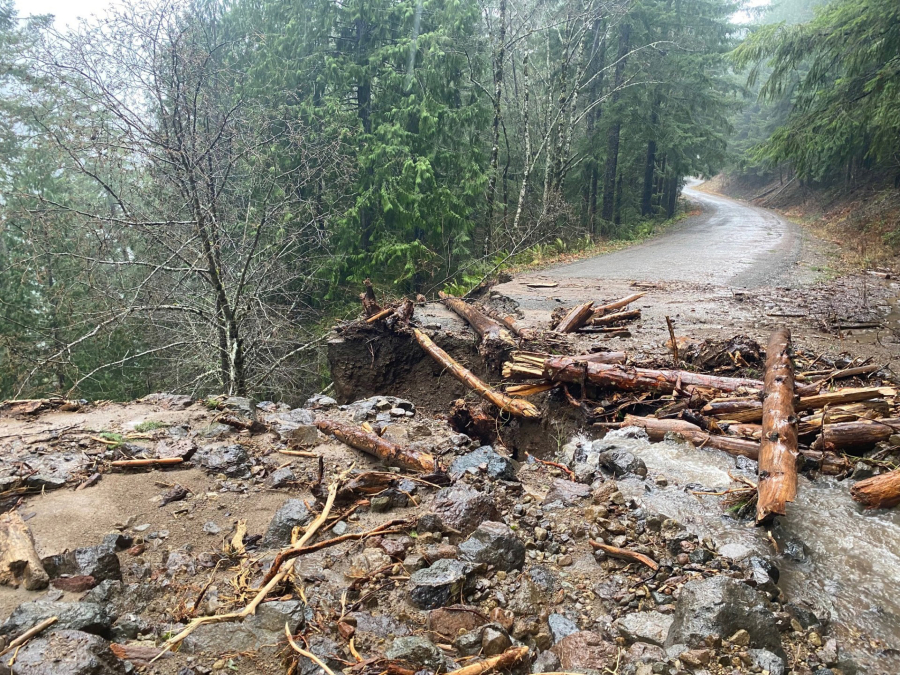
Several service roads in the forest remain closed after rockslides and mudslides blocked some roads, while others saw sections of the roadway washed away entirely. State Highway 12 and Highway 131, which provide access to the forest, were closed due to flooding.

Heavy rainfall can saturate and loosen soils, leaving trees vulnerable to toppling during high winds. It also can lead to erosion of riverbanks and inundate riparian areas, damaging wildlife habitat.

“Areas of particular concern include recent burn scars and the Mount St. Helens National Volcanic Monument. Burned areas have an increased likelihood of landslides, mudslides, flash floods, and debris flows due to the lack of vegetation and unstable soil,” according to the Forest Service’s news release.

The Mount St. Helens National Volcanic Monument is another area susceptible to landslides due to the presence of loose volcanic soil.

“Landslides or washouts are much more likely to occur among pre-disturbed areas like roads and trails,” according to the news release.

Clark County Public Works has been busy dealing with flooding at several parks, including Daybreak Regional Park. The boat launch at Daybreak was significantly damaged by floodwaters from the East Fork Lewis River. While all parks have been reopened, the boat launch remains closed until repairs can be made.

Public Works spokesperson Kaley McLachlan-Burton said periodic flooding is natural in stream and river systems and that most of what people consider damage after a flood is damage to human infrastructure.

“Major flood events can significantly change environments. Most damage, though, is from the interaction of floodwater with human-created or modified environments,” she said. “For example, before the 1996 floods, humans channelized the East Fork Lewis River, reduced its floodplain and built levees to control the river’s course. During the floods, the river broke through the levees and flooded former gravel-mining pits.”

Get the latest headlines in your email every week!

This field is for validation purposes and should be left unchanged.

As a result of the 1996 floods, the river shifted to the south, abandoning a long section of the channel that had been a spawning area for salmon, McLachlan-Burton said. Until this year, when the estuary partnership restored the floodplain and river channels and filled the former mining pits, significant ecological harm to the river, salmon and other wildlife species had been left unchecked for over three decades.

“That’s why projects like the East Fork Lewis River Reconnection project are essential,” McLachlan-Burton said. “The project reconnects the river with the floodplain, which is good for the environment, and also reduces erosion and flood risk for neighboring properties and infrastructure.”

In both rural and urban areas, heavy rain increases stormwater runoff, which can quickly overwhelm drainage systems and push rivers above flood levels.

“Unfortunately, there’s a lot of contaminants and trash that can flow into the river when stormwater facilities are overwhelmed,” Goodell said.

McLachlan-Burton said environmental damage from increased stormwater also happens when facilities that store, hold or contain potential pollutants are inundated.

“These impacts are usually short-term, though there are examples from other areas of the country where this has caused long-term damage,” she said.

The county also works in advance of storm season to prepare for flood events. McLachlan-Burton said staff practice and refine response procedures throughout the year, attend training and hold practice exercises.

“Immediately before potential severe weather, we actively monitor forecasts and observe conditions using information provided to local emergency managers by the National Weather Service. Our crews also provide valuable on-the-ground observations,” she said. “We have several levels of response activation. We actively collaborate with other local agencies during events, modify crew schedules as needed and can provide mutual aid to or request it from neighboring jurisdictions.”

Heavy rains and flooding do have some environmental benefits. Goodell said floods are a natural part of the ecosystem and play an important role in keeping rivers healthy.

“The addition of sediment brings much-needed nutrients that support the food web, and there has been research that shows large increases in macroinvertebrates and fish in the years following a large flood event,” she said.

The Forest Service urges visitors to the national forest to use caution and not to drive on roads that are underwater or that have been partially washed out from storm runoff.

Up-to-date information on road closures and weather alerts for the national forest are at www.fs.usda.gov/r06/giffordpinchot.