Camas-Washougal logo tag

C-Tran aims to weigh public support for tax increase to expand services

Transit agency to present 3 long-range plans that would cut, maintain or grow services

By
timestamp icon
category icon Clark County, Government, News

For C-Tran officials, the question is not, “If we build it, will they come?” but rather, “If we want to build it, will they pay for it?”

Residents across Clark County have said they want to see the transit agency expand its bus services, with more frequent stops and a better connected network, Taylor Eidt, the agency’s planning project manager, told C-Tran’s board of directors last month.

But getting there will require funds the agency simply does not have.

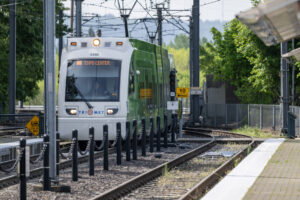
Eidt said C-Tran will grow from 334,000 to 365,000 fixed-route service hours, add another bus rapid transit Vine route on Highway 99 and expand the existing Fourth Plain Vine route over the next few years. But it will soon hit a point when operating costs outpace revenues.

“By 2030, we’re really going to be at the cap of what we can sustain with our current revenues,” Eidt said during a special board workshop June 9. “Beyond that, we’re not going to be able to increase our service.”

Residents and officials across Clark County, however, have been clear that they do not want to see the agency stagnate or cut services over the next two decades, he said. They have told C-Tran they want frequent transit service to schools, workplaces, retail centers and newly developed neighborhoods.

That would likely take a combination of higher sales taxes, more grant funding and higher passenger fares.

C-Tran staff will soon gauge people’s interest in three long-range plans that would either reduce, maintain or grow the agency’s services over the next 20 years.

  • Reduce: Under this plan, C-Tran would maintain its existing 0.7 percent sales tax and reduce bus service hours by 21 percent by 2045.
  • Maintain: This plan relies on a voter-approved sales tax rate increase (0.07 percent to 0.09 percent) and would preserve 2030-level services through 2045.
  • Grow: This is the plan recommended by C-Tran staff. Under this approach, voters would need to approve a 1.1 percent sales tax, which is beyond the agency’s maximum 0.09 percent taxing authority, but possible under a state rule, Eidt said. This would preserve the agency’s 2030 service levels and allow for new bus routes and capital projects.

Under the growth scenario, the agency could expand service in many of Clark County’s smaller cities, including the addition of a new bus route between Battle Ground and downtown Ridgefield and a Lake Road bus route in east Clark County to serve Camas High School, Washougal High School and the burgeoning Washougal waterfront development.

Revenue shortfall

C-Tran’s net operating expenses in 2025 were about $88.4 million. The vast majority of the costs went to staff for salaries and wages (41 percent) and benefits (31 percent), with the remainder paying for supplies (13 percent), services (10 percent) and other things like utilities, insurance, taxes and travel (5 percent).

Julie Syring, C-Tran’s chief financial officer, said the agency’s revenues are still growing but not fast enough to keep pace with increased expenses caused by inflation, tariffs and unexpectedly high fuel prices.

Sales tax revenues, which make up about 75 percent of the agency’s funding, continue to increase annually but at a slower rate, Syring said.

Between 2016 and 2025, the agency’s average annual sales tax revenues increased by 7.1 percent, including a high of 21 percent in 2021 and a low of 1.1 percent in 2024. The agency predicts sales tax revenues will increase by about 4 percent annually between 2027 and 2032. Meanwhile, Syring said, the agency’s expenses will likely grow by 7.3 percent annually.

The agency used one-time federal COVID-relief grants to help bolster its revenues between 2020 and 2024, but that funding is no longer available.

Likewise, a state transit support grant program funded by Washington’s Climate Commitment Act, which awarded $10.37 million to C-Tran during the 2025-27 grant cycle, will likely dry up by 2030, Syring said.

Fare increases

Syring told C-Tran officials June 9 that the agency will need to increase passenger fares in 2028, 2030 and beyond to help close the expected revenue shortfall.

The C-Tran board approved temporary fare reductions in January 2022 as Clark County was recovering from the impacts of the COVID-19 pandemic, but it has since greenlit a gradual fare restoration plan. Rates increased in 2024 and 2026.

“We have not yet gotten to our pre-fare reduction value,” Syring said. “As an example, prior to 2022, the local adult base fare was set at $1.80 and, effective January 2026, we are currently sitting at $1.50.”

Syring said the agency hopes to increase the adult fare from $1.50 to $1.75 in 2028 and from $1.75 to $2 in 2030.

“Following the 2030 increase, the forecast projects ongoing, smaller fare increases to occur every other year,” she said. “These increases are not automatic and would still be presented to the C-Tran board with a full public outreach process.”

Youth ages 18 and younger have been able to ride C-Tran buses — with the exception of the regional buses that go to Portland — for free since 2022.

Public outreach

Eric Florip, C-Tran’s communications director, said C-Tran staff will soon begin soliciting public feedback on the three long-range planning scenarios and try to gauge voters’ interest in increasing the agency’s sales tax.

C-Tran board member and Vancouver city Councilor Kim Harless said she thinks people would be more willing to pay a higher sales tax if it meant reduced travel times.

“I think that’s going to be a factor, when it’s actually a viable option to get from Point A to Point B in a time period that is near equivalent to driving,” Harless said during the June 9 workshop.

C-Tran board member Tim Hein, who represents the city of Camas, said he doesn’t want to move forward with planning for the growth scenario until the board knows voters are willing to back a higher sales tax rate.

“In the end, you’ve got to know how much and how willing people are to pay for it, in a time when it’s really difficult to get people to pay more on the federal, state and local level. That’s my primary concern,” Hein said. “I think the ideas are great, the scenario is great, but how much does it cost? And are people really willing to pay for it?”

Get the latest headlines in your email every week!

This field is for validation purposes and should be left unchanged.