Camas-Washougal logo tag

Endangered turtles get a boost

Oregon Zoo and Washington Dept. of Fish and Wildlife release 22 northwestern pond turtles captured in the Columbia River Gorge last year back into the gorge area on Thursday.

By
timestamp icon
category icon Clark County, Environment, News, Outdoors
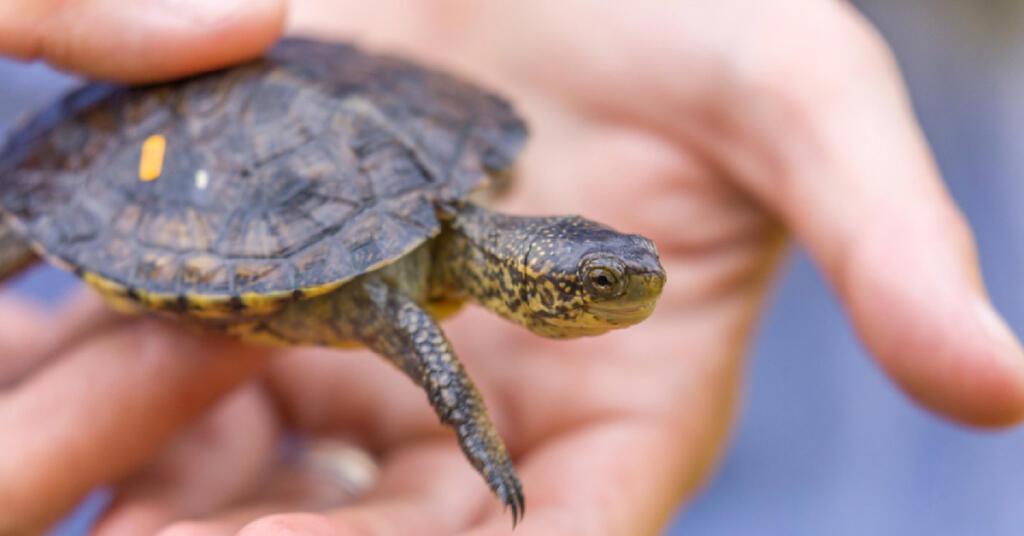
The Oregon Zoo released 22 northwestern pond turtles along the Columbia River Gorge this week. The zoo has been working with the Washington Department of Fish & Wildlife and other partners to catch, grow and release the endangered turtles in hopes of increasing their chances for survival in the wild. (The Columbian files)

With the help of volunteers and wildlife officials, the Oregon Zoo returned 22 endangered northwestern pond turtles to the Columbia River Gorge this week.

Washington Department of Fish & Wildlife biologists collected the turtles as hatchlings from sites in the Gorge last spring. From there, they were taken to the zoo’s conservation lab, where wildlife experts provided heat lamps and plentiful food to help the turtles grow quickly.

“In a year, they grew to about the size of 3-year-old turtles,” Jen Osburn Eliot, who oversees the zoo’s turtle conservation program, said in a press release. “Head-starting the turtles in the lab gives them a much better chance of survival in the wild.”

The northwestern pond turtle, also known as the western pond turtle, is listed as an endangered species in Washington and a sensitive species in Oregon. In the 1990s, Fish & Wildlife officials discovered that the number of northwestern pond turtles living in the wild was in sharp decline, with only around 150 of them extant. The state agency then began working with the Oregon Zoo in Portland and the Woodland Park Zoo in Seattle to catch, grow and release turtles.

Britton Ransford, communication manager for Fish & Wildlife’s southwest region, said raising the hatchlings in a controlled environment for nine to 10 months lets the turtles grow large enough to avoid predation by bullfrogs and other animals.

“The bigger the turtle, the harder it is for a bullfrog to gobble it up,” Eliot said in the release.

Although native to the eastern United States, the American bullfrog is an invasive species in Washington. The largest frog species on the continent, it can tip the scales at more than a pound. The frogs have been driving pond turtles and other small, vulnerable aquatic species to the brink of extinction, Eliot said.

“More than 1,600 northwestern pond turtles have been released at carefully selected, suitable habitat sites in the Columbia River Gorge since the program began in 1991,” Ransford said.

Keepers prepare the turtles for life outdoors by giving them plenty of time outside to acclimate to changing temperatures, as well as adjusting their diet to mimic what they’ll find in their new pond home.

Today, there are around 800 northwestern pond turtles in the wild. Nearly all are connected to the Fish & Wildlife/zoo programs.

“Every turtle we put back in a pond matters,” Eliot said. “We need to do our part to keep the population going.”

The Northwestern Pond Turtle Recovery Project is a collaborative effort by the Oregon Zoo, Woodland Park Zoo, Washington Department of Fish & Wildlife, U.S. Fish and Wildlife Service, Friends of the Columbia River Gorge, Bonneville Power Administration, U.S. Forest Service and other partners.